Author: Speed Cooking

  • What Is Seaweed Salad? Wakame Explained

    What Is Seaweed Salad? Wakame Explained

    It is the vivid green tangle that turns up on appetiser lists at almost every sushi restaurant, and it looks like nothing else on the menu. Most people either order it every time or have never ordered it at all.

    What is seaweed salad?

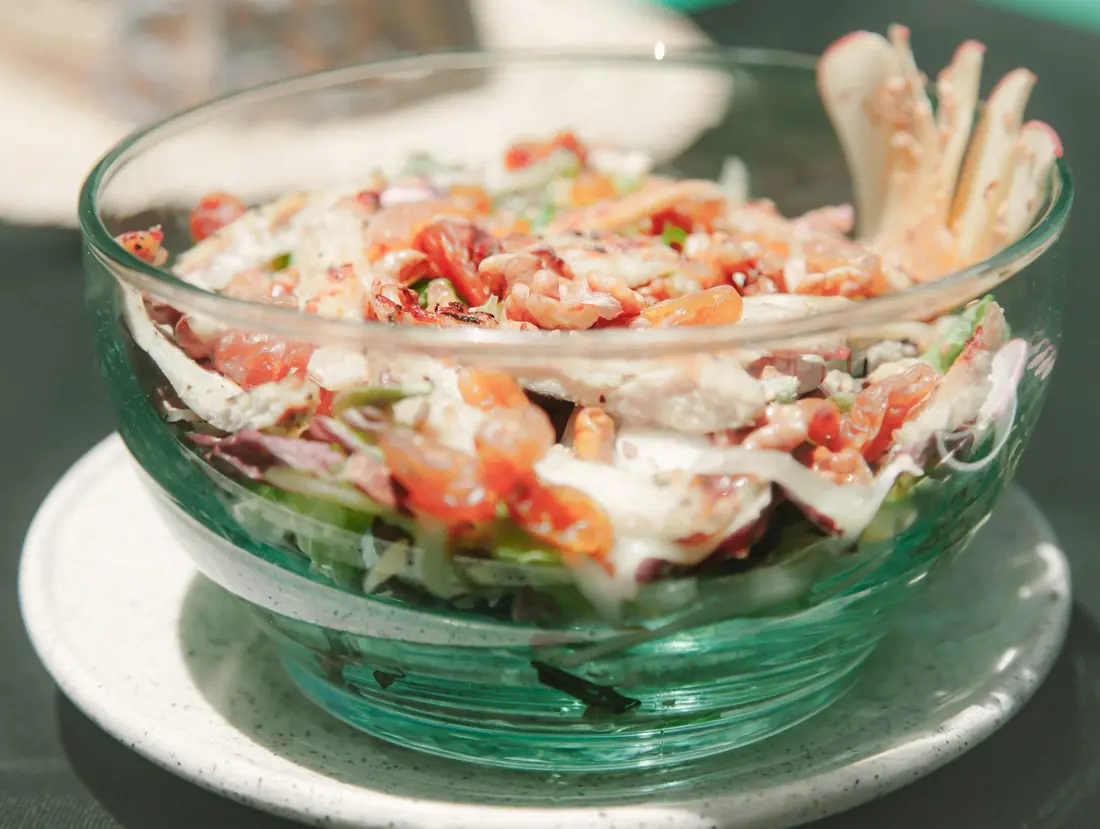
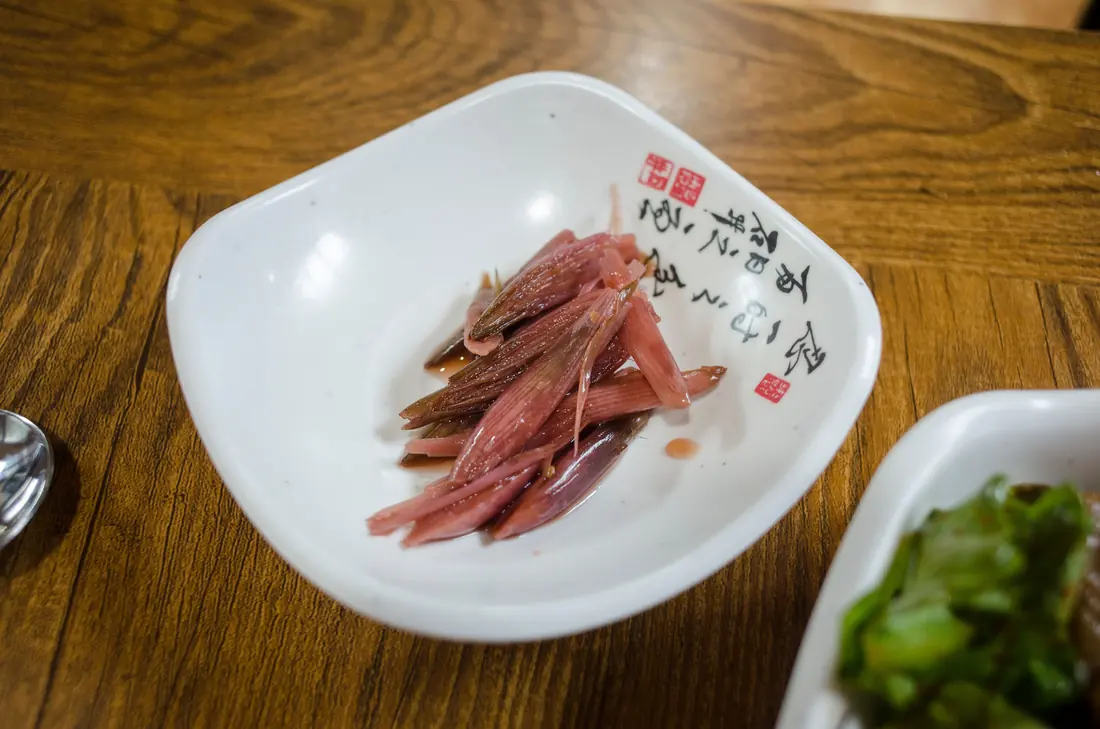
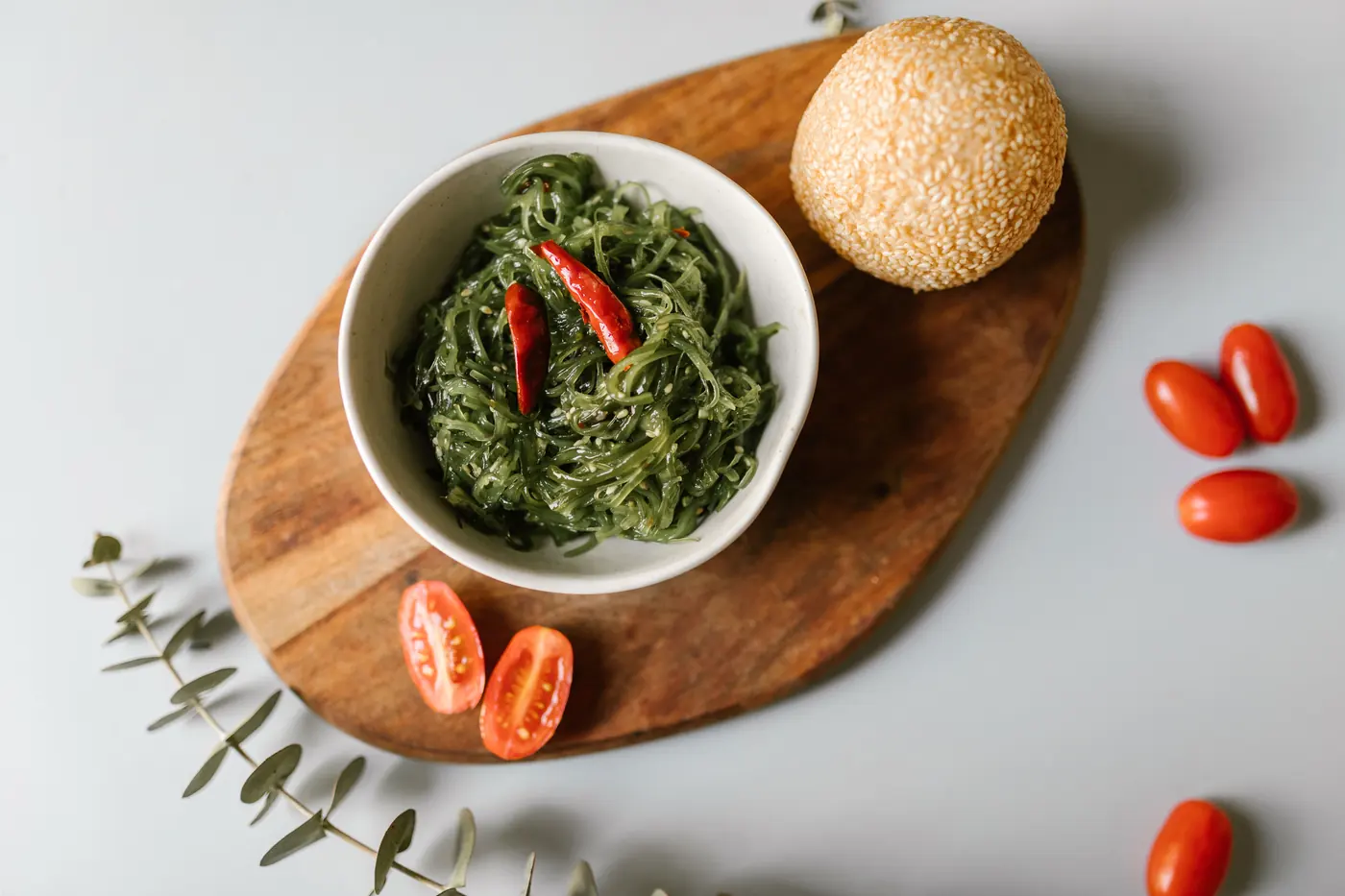
    Seaweed salad is an edible seaweed – usually wakame – rehydrated and dressed with sesame oil, vinegar and sesame seeds. It is served cold, in a small portion, as a starter or a side.

    The texture is the thing that surprises people. It is not soft or slippery in the way the appearance suggests. It has a definite spring to it, closer to a firm noodle than to a leaf.

    Brown kelp at the water's edge

    What the seaweed actually is

    Wakame is a brown seaweed, despite what ends up on the plate. It grows in cool coastal waters, has been farmed in East Asia for centuries, and is one of the most widely cultivated seaweeds in the world – NOAA covers the scale of seaweed aquaculture and how it is grown.

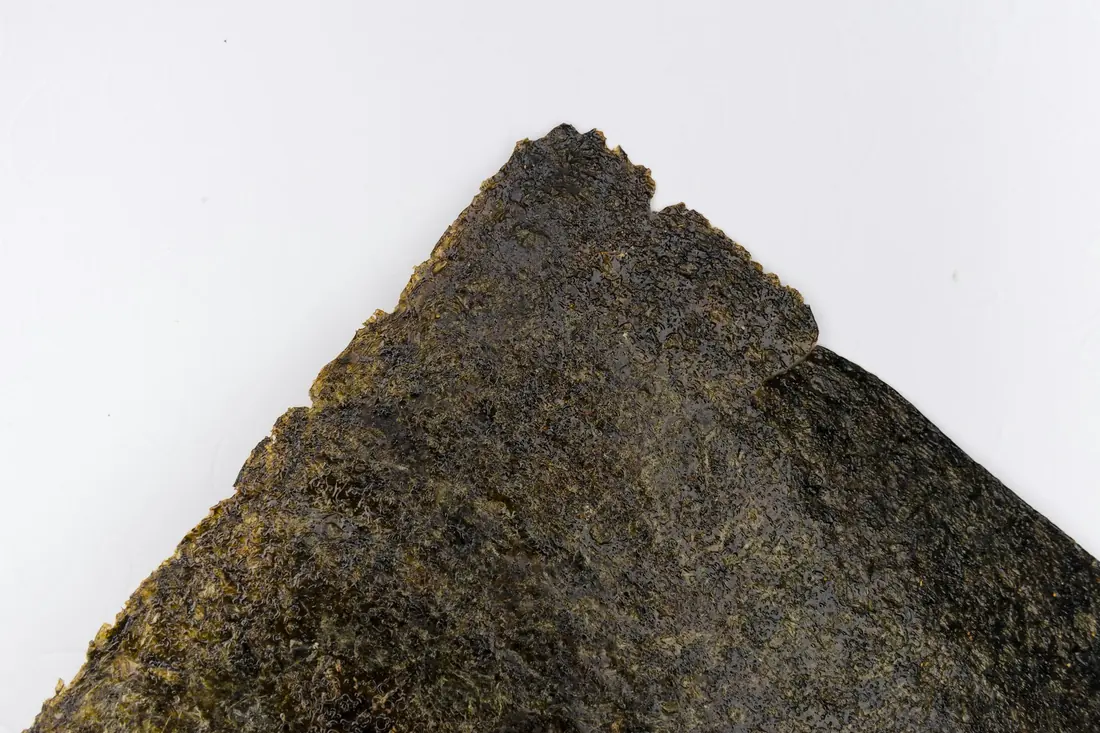
    It arrives at a restaurant dried, in dark compressed pieces, and is rehydrated in water before use. It expands considerably when it does – a small handful of dry seaweed becomes a bowlful.

    Kelp growing underwater

    Why it is so green

    The colour is the most-asked question and it has a straightforward answer. Wakame shifts from brown to bright green when it hits hot water, because heat breaks down the brown pigment and reveals the green underneath.

    Some prepared versions are also coloured to make that green more uniform, which is why restaurant seaweed salad tends to be a more emphatic colour than a home-made version. Both start from the same seaweed.
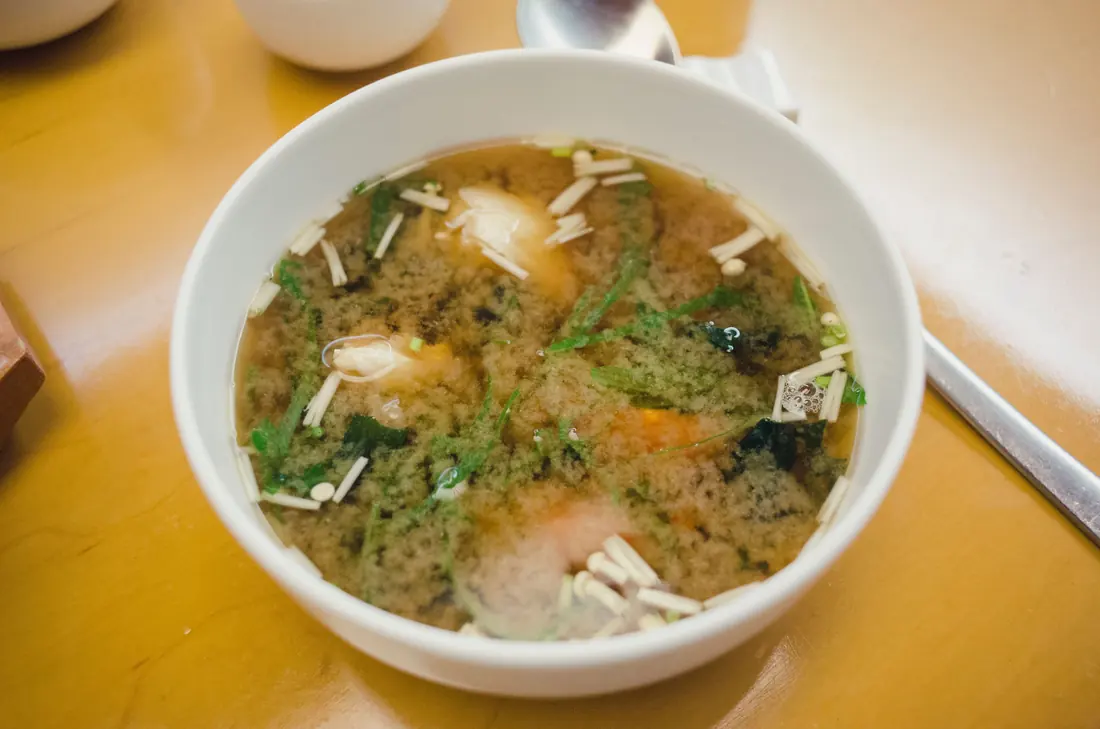
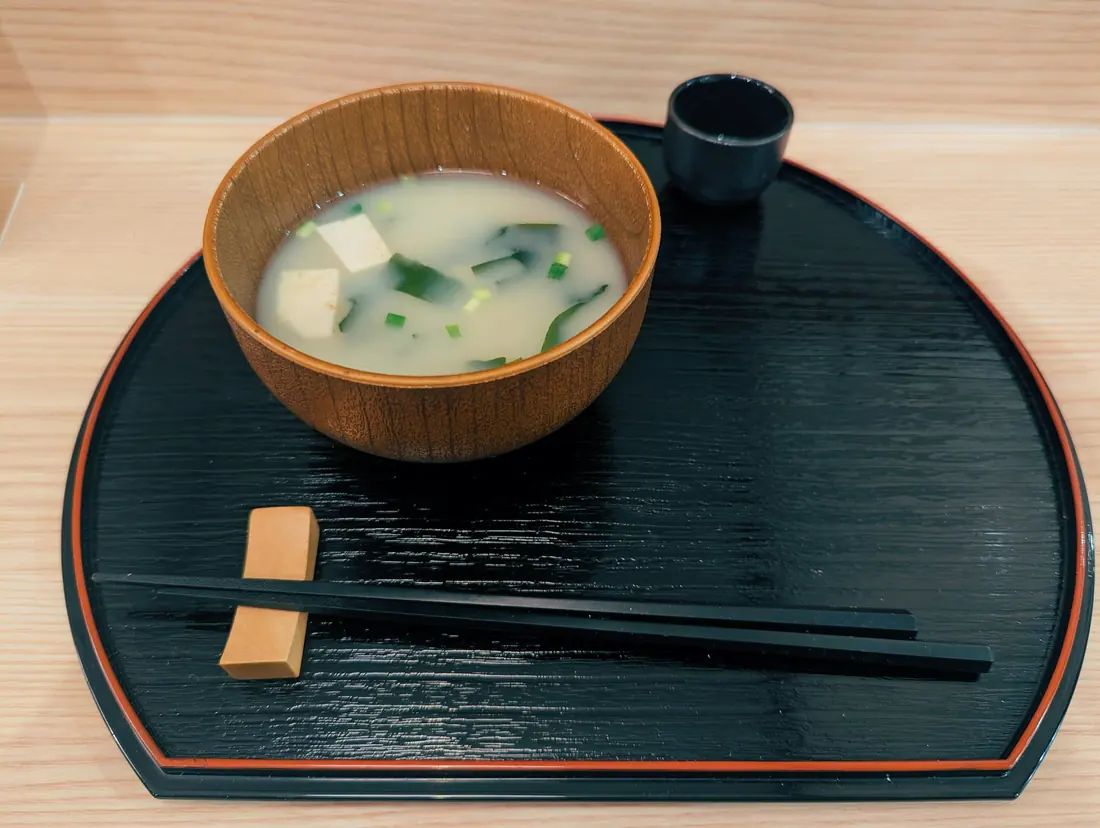
    A bowl of miso soup with tofu and seaweed

    What goes into the dressing

    The dressing is where restaurants differ, but the components are consistent.

    • Sesame oil – the dominant flavour, toasted and nutty.
    • Rice vinegar – the sharpness that keeps it from being heavy.
    • A little sweetness – usually sugar or mirin, balancing the vinegar.
    • Sesame seeds – scattered through, adding texture as much as flavour.
    • Sometimes chilli – a small amount of heat in some house versions.

    Occasionally you will find slivers of cucumber or carrot mixed through it. That is a house variation rather than a different dish.
    Sesame seeds

    How it is prepared

    There is more to it than mixing, and the steps explain why restaurant versions are consistent while home attempts often are not.

    1. The dried seaweed is soaked in cool water until it opens out, which takes only a few minutes and expands it several times over.
    2. It is drained and then squeezed firmly, because water left in the strands dilutes the dressing and makes the whole thing limp.
    3. It is cut into even lengths, so it can be picked up cleanly rather than arriving as one tangle.
    4. It is dressed and then left to sit, which lets the sesame and vinegar work into the strands rather than coating them.

    The squeezing step is the one most often skipped and the one that matters most. It is the difference between springy and soggy.

    How it differs from the seaweed elsewhere on the menu

    Seaweed saladNoriSeaweed in miso soup
    TypeWakame, usuallyPressed sheetsWakame, usually
    FormLong shredded strandsFlat dried sheetSmall soft pieces
    ServedCold, dressedWrapped around riceFloating in hot broth
    TextureSpringy and firmCrisp, then softSoft
    FlavourSesame and vinegarToasted and savouryMild, takes on the broth
    The same family of ingredient in three different roles

    It is worth knowing that the seaweed in a miso soup and the seaweed in the salad are frequently the same thing, prepared completely differently. If you like one and not the other, it is the preparation you are responding to.
    A dark broth with seaweed and vegetables

    One practical note on colour: a duller, browner green is not a sign that anything is wrong. It usually means the seaweed has not been dyed, and the flavour is unaffected either way.

    What it tastes like

    Sesame first, then vinegar, then a clean mineral flavour underneath that is the seaweed itself. It is savoury and slightly sweet, and the sea note is much milder than the appearance suggests.

    If you have avoided it on the assumption that it tastes strongly of the sea, that assumption is worth testing. The dressing does most of the talking.

    Why the portion is small

    Seaweed salad almost always arrives in a small mound rather than a bowlful, and that is deliberate rather than mean. The dressing is concentrated, the texture is assertive, and the flavour does not fade as you eat it.

    A large portion of it would dominate a table in a way a leaf salad would not. It is built to be a counterpoint – a few forkfuls between other things – rather than something to work through.

    When to order it

    It works best in the same slot as a palate cleanser – early, or alongside something rich. The vinegar and the cold temperature both cut through fried food, which is why it sits comfortably next to an order of anything crisp.

    Portions are small, which makes it easy to add to a table without committing much. It is also one of the few appetisers that holds up well if it sits for a few minutes, because it is already cold and already dressed.

    Other seaweed dishes you may come across

    Wakame dressed with sesame is by far the most common version, but seaweed is a broad category and a few other preparations turn up in Japanese and wider East Asian cooking.

    • Kombu – a thick kelp used mainly to build broth rather than eaten as a salad, though it is sometimes sliced and served.
    • Hijiki – fine dark strands, usually simmered rather than dressed cold, with a much softer texture.
    • Cucumber and wakame – the same salad with thin cucumber slices through it, sharper and lighter than the plain version.

    If you enjoy the standard version, these are the natural next steps, and all of them start from the same idea of treating seaweed as a vegetable rather than a garnish.

    It also sits well next to almost anything. Because the dressing is sesame and vinegar rather than anything creamy or heavy, it does not compete with a soup, a grilled plate or a tray of rolls, which is part of why it turns up on so many tables as an extra rather than a decision.

    Does it travel?

    Better than most things. It is served cold, it does not depend on a crisp texture, and the dressing is already on it, so nothing is lost between the kitchen and home.

    The only thing worth doing is keeping it separate from anything hot in the bag. It is at its best cool, and it will sit happily in the fridge for a short while if the rest of the meal arrives first.

    If seaweed is new to you, the soup comparison covers where else it turns up on the menu, and the beginners guide to rolls explains the pressed sheets that hold a roll together. The current selection is on the ordering page.

    Frequently Asked Questions

    What is seaweed salad made of?

    Rehydrated seaweed, usually wakame, dressed with sesame oil, rice vinegar, a little sweetness and sesame seeds. It is served cold.

    Why is seaweed salad so green?

    Wakame is brown when dried and turns bright green when it meets hot water, as heat breaks down the brown pigment. Some prepared versions are also coloured for consistency.

    What does seaweed salad taste like?

    Sesame and vinegar lead, with a clean mineral flavour underneath. It is much milder than most people expect, and the texture is springy rather than soft.

    Is it the same seaweed as in miso soup?

    Often yes – wakame is used in both. The difference is preparation: shredded and dressed cold for the salad, in small soft pieces in hot broth for the soup.

    Is seaweed salad the same as nori?

    No. Nori is pressed into flat sheets and used to wrap rolls. Seaweed salad is a different form entirely, served loose and dressed.
  • What Is Edamame? How to Eat It

    What Is Edamame? How to Eat It

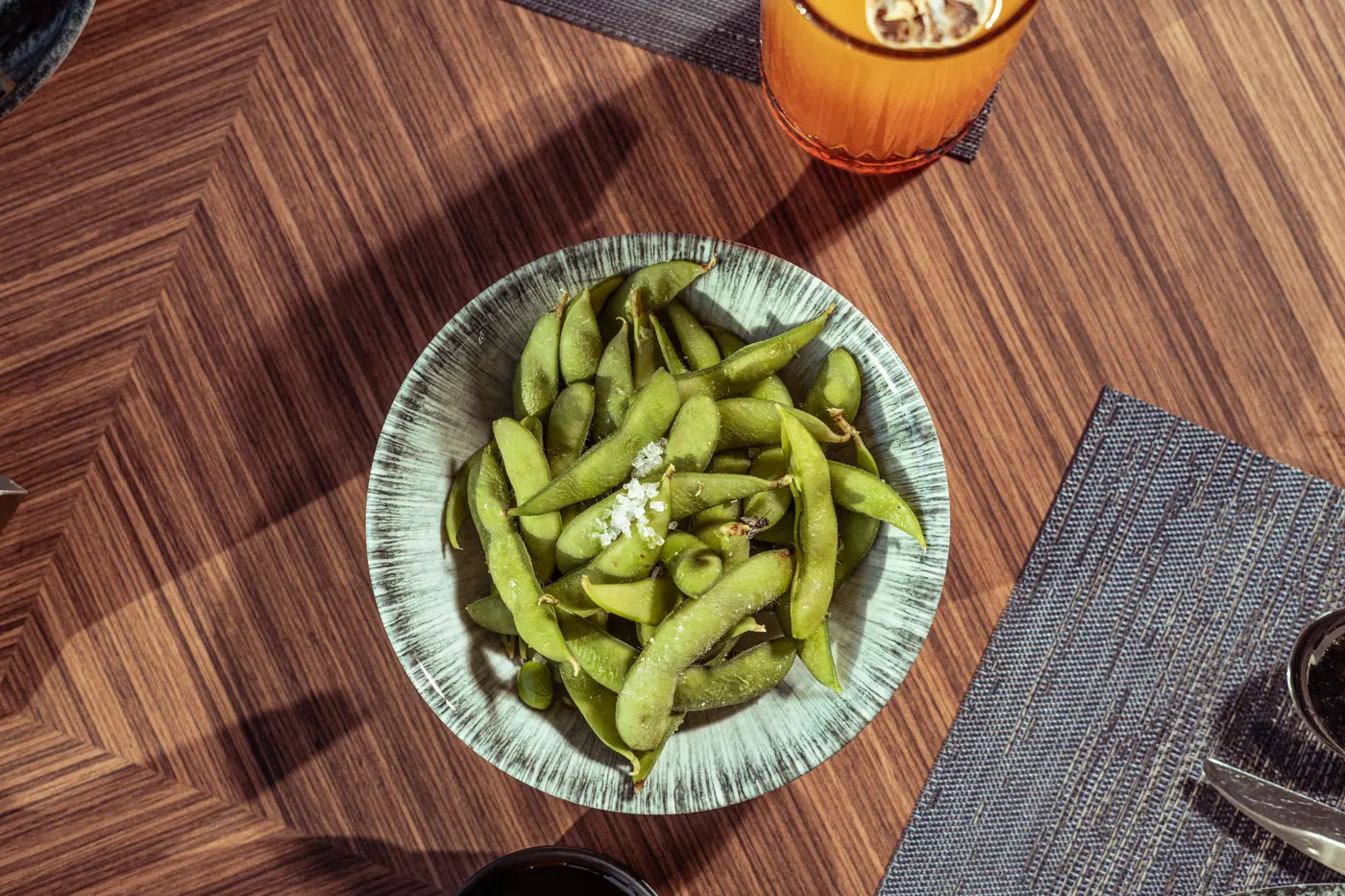
    A bowl of bright green pods arrives, and if you have not met them before it is not immediately obvious what to do. Edamame is one of the simplest things on any Japanese menu, and one of the easiest to get wrong on the first try.

    What is edamame?

    Edamame is a young soybean, picked while the pod is still green and the beans inside are soft. The pods are boiled or steamed, salted, and served warm or cold in a bowl to be eaten with your hands.

    The name is descriptive rather than exotic – it refers to beans on a branch, which is how they were traditionally sold and eaten.

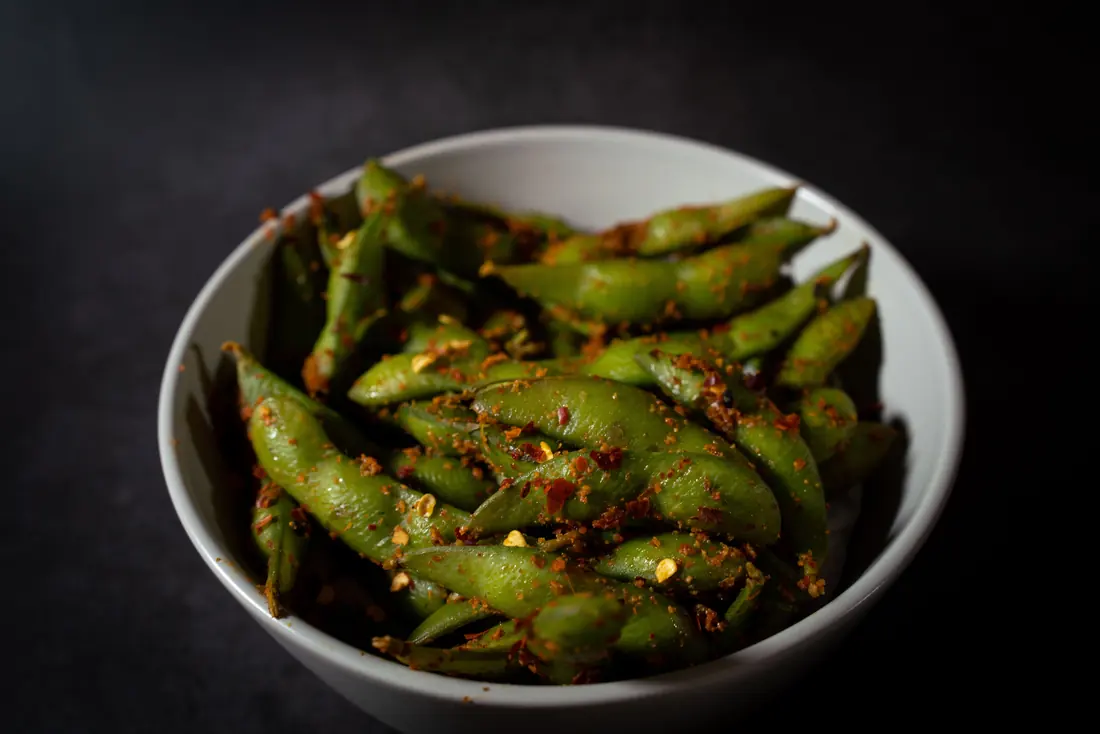
    Edamame pods tossed with seasoning in a bowl

    No, you do not eat the pod

    This is the single most common question about edamame, and the answer is that the pod is a container, not part of the dish. It is fibrous and tough and is not meant to be chewed.

    What you eat are the beans inside. The pod’s job is to hold the salt on the outside and to keep the beans from drying out, and both of those are reasons the beans are cooked in it rather than shelled first.

    How to eat it

    1. Pick up a pod with your fingers. Chopsticks are unnecessary and awkward here.
    2. Put one end in your mouth and draw the pod through your teeth, so the beans pop out as it passes.
    3. The salt on the outside of the pod comes with them – that is the point of the technique.
    4. Put the empty pod in the second bowl, or on the side of the first if only one arrives.

    If you shell them by hand and eat the beans on their own, you get the beans without the seasoning, which is why the drawing-through method is standard rather than fussy.

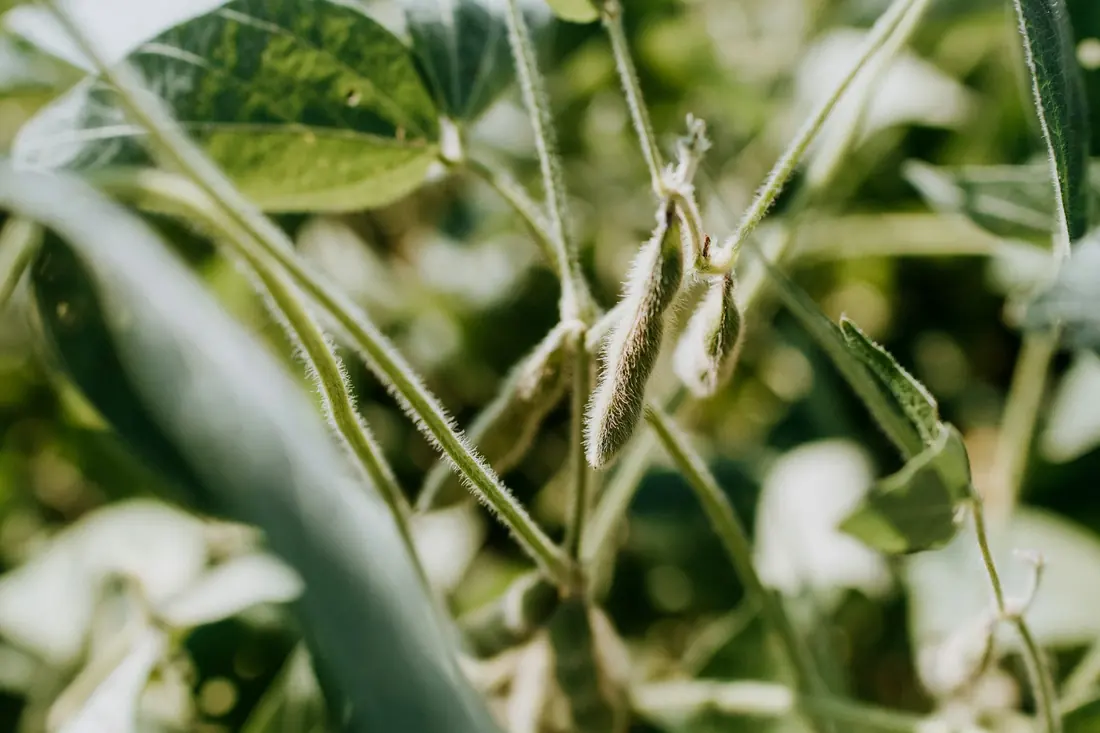
    Soybean pods growing on the plant

    Where it comes from

    Soybeans have been cultivated in East Asia for thousands of years and are one of the most widely grown crops in the world; Britannica’s entry on the soybean covers how far that cultivation reaches.

    Most of that crop is harvested mature and dry, when the beans are hard and pale. Edamame is the same plant caught earlier, while the pods are still green and the beans are tender enough to eat directly.

    That timing is the whole difference. A mature soybean needs long cooking or processing before it is edible; a young one needs a few minutes in salted water.

    Steam rising from a pot on the stove

    How it is cooked

    The method is short and there is not much to it. The pods go into boiling salted water for a few minutes, or into a steamer for slightly longer, and come out while the beans are still firm.

    They are then salted again on the outside, which is the step that matters most for how it eats. Salt on the pod is what you taste first, and it is the reason the beans need no seasoning of their own.

    Overcooking is the only real way to spoil it. A pod left too long goes olive-drab and the beans turn mealy, which is why the bright green colour is a reasonable signal that a bowl has been handled properly.

    Edamame and other soy foods

    EdamameTofuMiso
    Made fromYoung green soybeansCurdled soy milkFermented soybean paste
    ProcessingAlmost none – cooked in the podPressed into blocksFermented over months
    TextureFirm, faintly sweet beansSoft to firm, mildThick savoury paste
    ServedIn the pod, saltedIn soup, fried, grilledDissolved into broth
    Eaten asA starterPart of a dishA seasoning
    Three soy foods you will meet on the same menu

    It is a useful comparison because the three turn up together constantly and appear to have nothing in common. They are the same bean at three completely different stages of processing.

    The pods are also a rare case where the serving vessel matters. A wide shallow bowl lets them cool evenly and stays easy to reach across a table; a deep one keeps the bottom layer warm but makes the last few awkward to get at.

    Warm or cold?

    Both are correct. Served warm, straight from the pot, the beans are softer and the salt is more noticeable. Served chilled, they are firmer and the sweetness comes through more clearly.

    Restaurants vary in which they do, and neither is a mistake. If a bowl arrives cold and you were expecting warm, that is a house preference rather than an oversight.

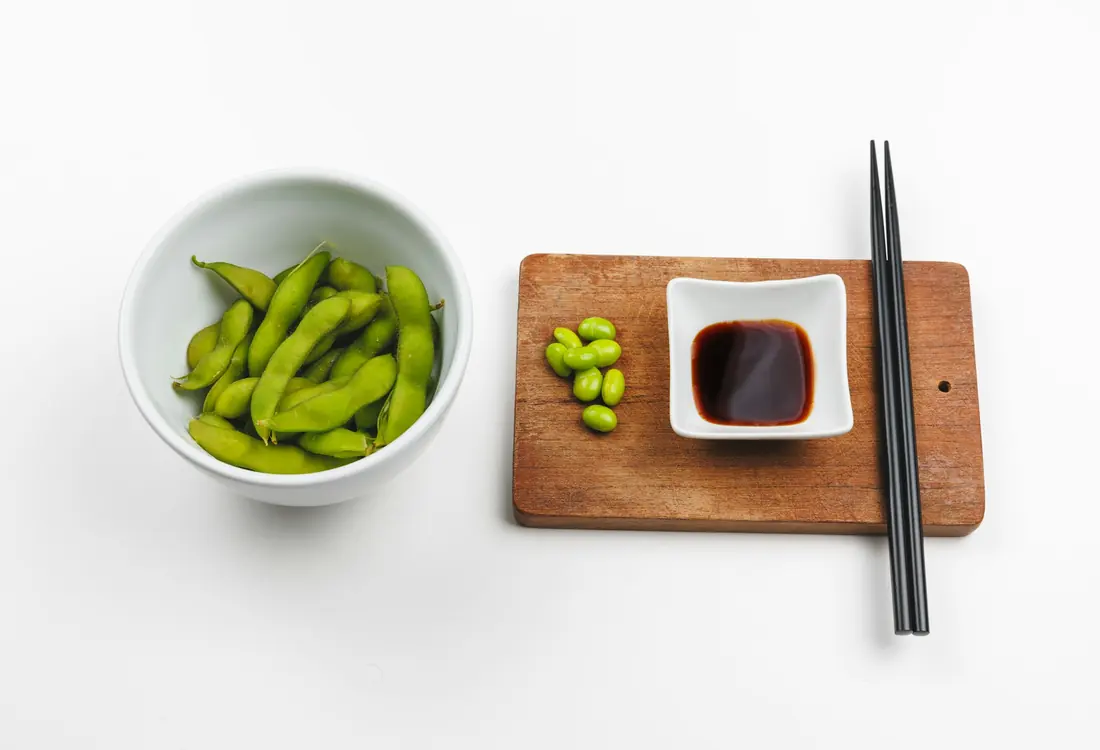
    A bowl of edamame set out with chopsticks

    Seasoned versions

    Plain salted is the standard, but seasoned versions are increasingly common and worth trying if you already know you like the plain one.

    • Chilli – flakes or a light coating of oil, adding heat without changing the texture.
    • Garlic – usually tossed through after cooking, so it stays on the outside of the pod where you will actually taste it.
    • Black pepper or togarashi – a dry seasoning blend scattered over the top.

    All of these work for the same reason the salt does. The seasoning sits on the pod, and the pod passes it to you on the way past.

    Why it works as a starter

    Edamame does something specific at the start of a meal that few other appetisers manage. It occupies a table without filling anyone up, and it takes a while to eat because each pod is a small separate action.

    That makes it a natural thing to put down while the rest of an order is being prepared, particularly with a group, and particularly with children, who tend to find the mechanics of it entertaining.

    It is also about as uncomplicated as restaurant food gets – a vegetable, boiled, with salt – which makes it an easy first thing to put in front of someone who is unsure about the rest of the menu.

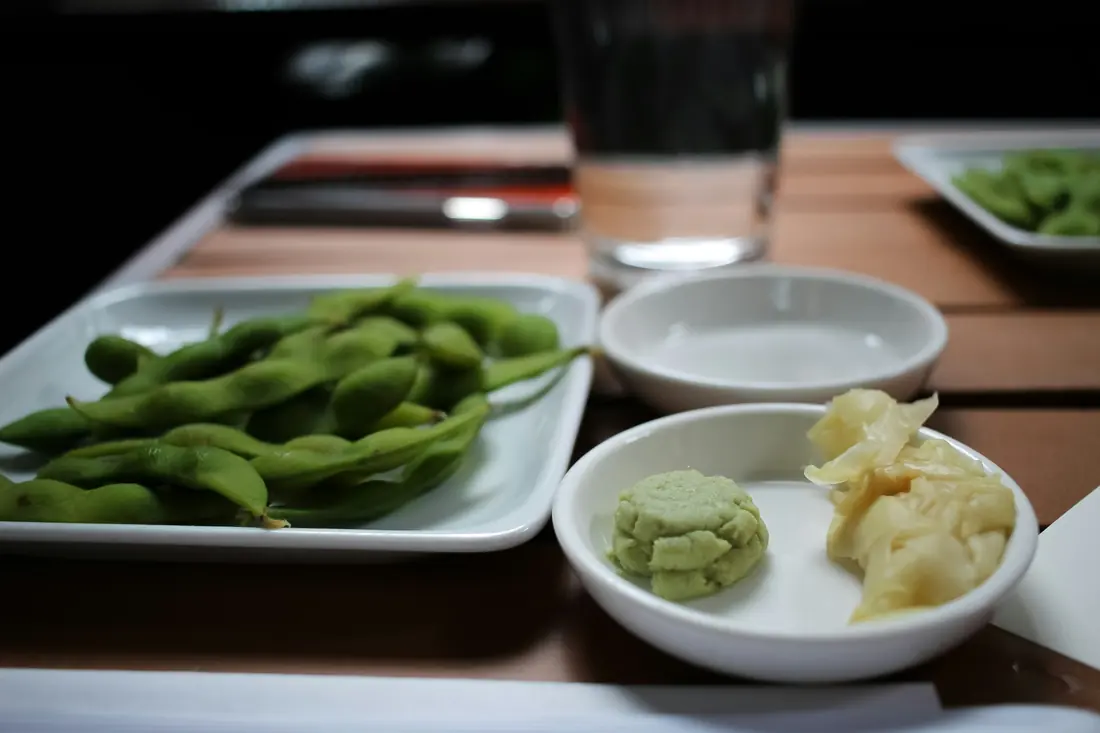
    Edamame pods served on a restaurant table

    Shelled edamame

    You will also come across the beans sold already shelled, without the pods. This is the form used when edamame is an ingredient rather than a dish – scattered through a salad, folded into a rice bowl, or blended into a dip.

    It is the same bean, but the experience is different enough that it is worth treating as a separate thing. Shelled beans lose the salt-on-the-outside trick entirely, so they are seasoned directly and usually taste milder as a result.

    A few practical notes

    • Two bowls is normal. One holds the pods, the other takes the empties. If only one arrives, a corner of the table or the edge of the bowl is fine.
    • Fingers are correct. This is a hands-on dish and nobody expects otherwise.
    • The salt is on the outside. Adding more to the beans after shelling does not do the same thing.
    • Order it early. It is best while warm, and it is designed to arrive before everything else.

    It sits alongside the other soy dishes on the menu, so our guide to tofu covers the pressed version of the same bean and the soup comparison covers the fermented one. The current selection is on the ordering page.

    Frequently Asked Questions

    Are you supposed to eat the edamame pod?

    No. The pod is tough and fibrous and is not eaten. Draw the pod through your teeth so the beans come out, then discard the empty pod.

    What does edamame taste like?

    Mild, faintly sweet and slightly grassy, with a firm texture. Most of the salt you taste is on the outside of the pod rather than on the beans themselves.

    Is edamame the same as a soybean?

    It is the same plant, harvested young. Edamame pods are picked while still green and the beans are soft; mature soybeans are left to dry and become hard.

    Is edamame served hot or cold?

    Both are common. Warm brings out the salt, chilled brings out the sweetness. Which one arrives is a matter of house preference.

    Do you eat edamame with chopsticks?

    Fingers are normal and easier. The technique of drawing the pod through your teeth does not really work with chopsticks.

  • Egg Rolls vs Spring Rolls: What’s the Difference?

    Egg Rolls vs Spring Rolls: What’s the Difference?

    These two names get used interchangeably, and on a lot of menus they are describing genuinely different things. The confusion is worth clearing up, because ordering one when you wanted the other is a common and easily avoided disappointment.

    The short answer

    An egg roll is thick, bubbly and deep fried in a wheat-flour wrapper. A spring roll is thinner – and it may be either fried in a delicate wrapper or served fresh and unfried in translucent rice paper.

    So the real distinction is not two things but three, and the third is where most of the confusion comes from.

    Translucent fresh rolls filled with herbs and vegetables

    What an egg roll is

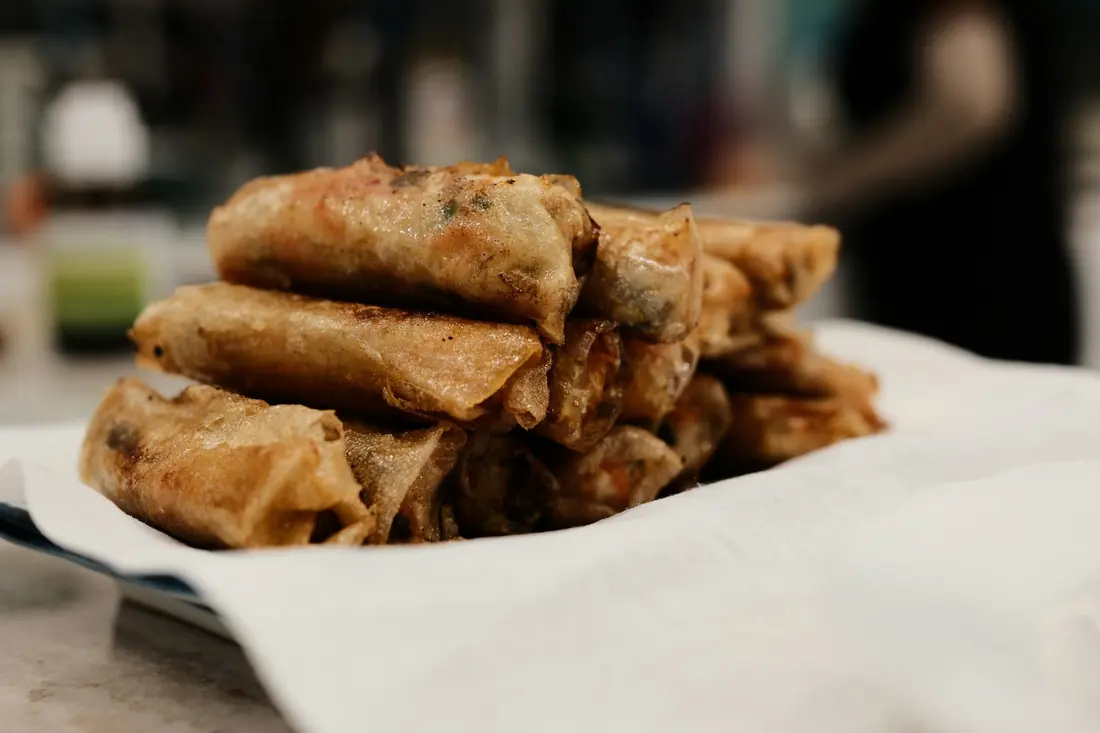
    An egg roll is the substantial one. The wrapper is a thick wheat dough, the filling is usually cabbage-based with a protein, and deep frying gives the outside its characteristic blistered, bubbled surface.

    It is an American-Chinese restaurant staple rather than a dish with a long history in China, and it is built for that setting: filling, sturdy, and good with a sweet dipping sauce.

    What a spring roll is

    Spring rolls are the older and broader category. The name refers to the season – they were eaten to mark the beginning of spring, filled with the first vegetables of the year. Britannica’s entry on the spring roll traces that origin.

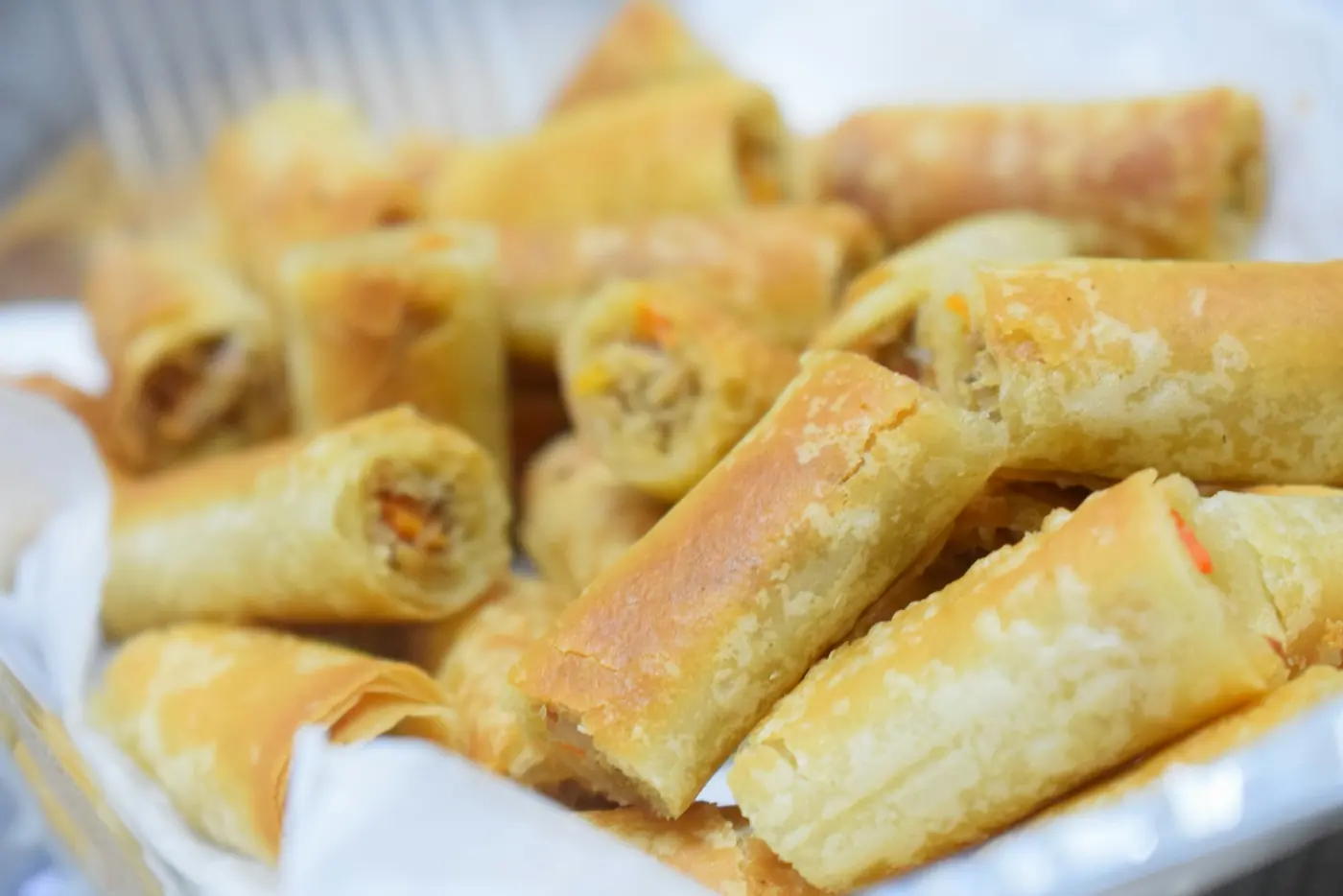
    Fried spring rolls use a much thinner wrapper than an egg roll, so they come out crisp and light rather than chewy. They are usually smaller, and there are usually more of them.

    Thin crispy fried rolls stacked on a board

    And then there are fresh rolls

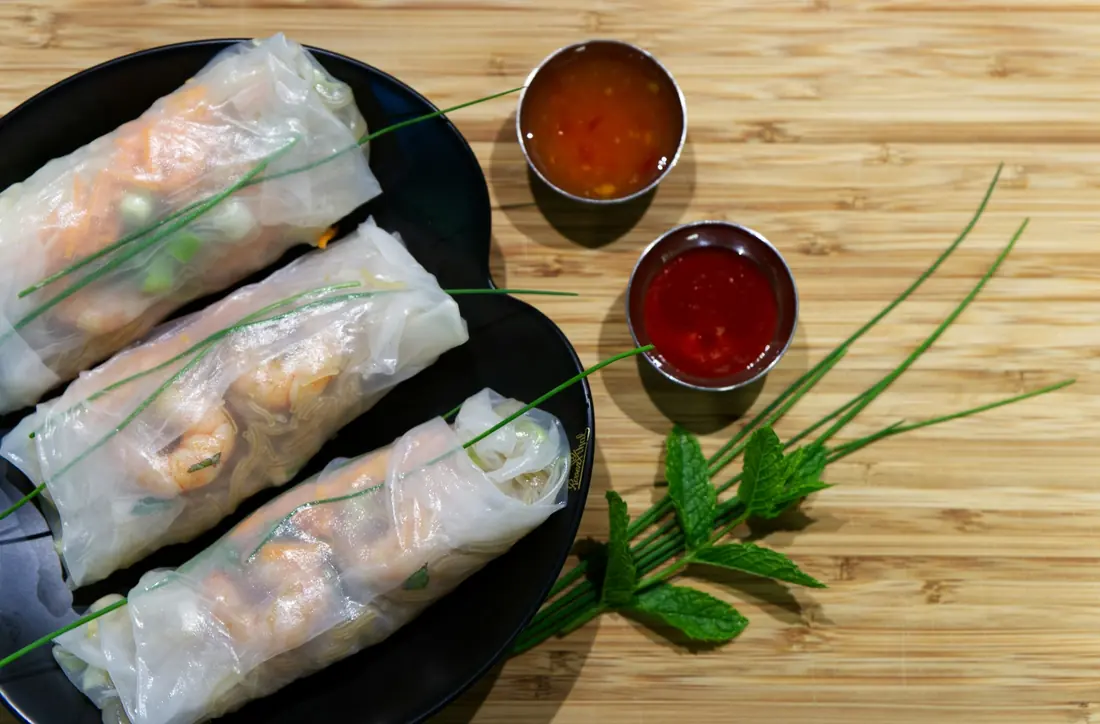
    The third thing is the one people are often actually thinking of. Fresh rolls are wrapped in softened rice paper, are not fried at all, and are served cold – translucent, so you can see the herbs and vegetables inside.

    They are frequently listed as spring rolls, sometimes as summer rolls, and occasionally as fresh rolls. If the description mentions rice paper, herbs, or serving with a dipping sauce and no mention of frying, that is what you are getting.

    A vegetable filling being rolled into a wrapper

    What goes inside them

    Cabbage does most of the work in both fried versions, and there is a practical reason for it. Shredded cabbage holds its shape through frying, releases very little water into the wrapper, and stays pleasant to eat when hot.

    Around it you will usually find carrot for colour and sweetness, sometimes bean sprouts or mushroom for texture, and often a small amount of protein – the filling is vegetable-led rather than meat-led even when meat is listed.

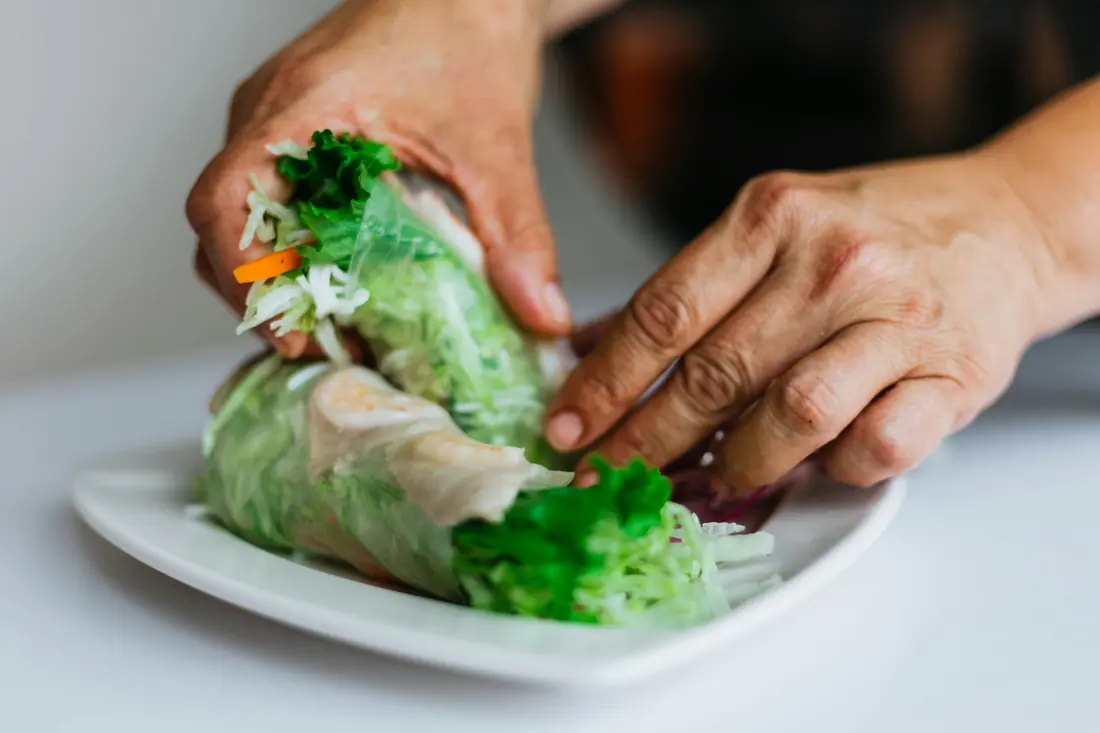
    Fresh rolls work on completely different principles. Nothing is cooked into submission, so the filling is built from things that are good raw and cold: leaves, herbs, thin vegetable strips, cooked shrimp or slices of cooked meat, and sometimes a small bundle of soft noodles.

    The three compared

    Egg rollFried spring rollFresh roll
    WrapperThick wheat doughThin wheat pastryRice paper
    CookedDeep friedDeep friedNot cooked
    SurfaceBubbled and roughSmooth and crispSoft and translucent
    ServedHotHotCold
    SizeLarge, few per orderSmaller, several per orderMedium, cut in half
    FillingCabbage and proteinVegetables, sometimes proteinHerbs, vegetables, protein
    Egg rolls, fried spring rolls and fresh rolls side by side

    The wrappers, in more detail

    Everything about how these behave comes down to the wrapper, and the three are not variations on one thing.

    • Egg roll wrapper – a thick wheat dough. In hot oil it puffs and blisters, which is where the rough bubbled surface comes from, and it stays substantial enough to be chewy rather than shattering.
    • Spring roll pastry – a much thinner wheat sheet. It crisps almost immediately and stays smooth, so the result is light and snaps rather than chews.
    • Rice paper – a dried translucent sheet that is not fried at all. It is dipped briefly in water until pliable, then wrapped while still slightly firm, because it continues to soften as it sits.

    This is also why they cannot be swapped. Rice paper in a fryer behaves nothing like wheat pastry, and an egg roll wrapper served unfried would be inedible.

    How to tell which one a menu means

    Menu wording is inconsistent between restaurants, but a few signals are reliable.

    • “Crispy” or “fried” means it is going to arrive hot in a fried wrapper.
    • “Fresh”, “summer” or “rice paper” means the cold, unfried version.
    • A herb list – mint, cilantro, basil – almost always indicates a fresh roll, because those herbs would be wasted in a fryer.
    • A count in the description – two pieces usually means fresh rolls cut in half; four or more usually means fried.

    Where a menu says only “spring roll” with no other detail, fried is the safer assumption.

    A small bowl of red dipping sauce on a tray

    One more thing to watch for is the count. A menu that lists a piece count is usually being precise about it, and two of something is a very different order from six of something when you are feeding more than one person.

    Which to order

    It depends less on preference than on what else is coming.

    1. Ordering something rich and fried already? Fresh rolls balance the table.
    2. Ordering soup or something light? A fried roll gives the meal some contrast.
    3. Feeding a group with varied tastes? Fried spring rolls divide more evenly than egg rolls, because there are more of them.
    4. Eating at home rather than in? Egg rolls survive the trip best of the three.

    The sauces that come with them

    The sauce is usually a good indication of which roll you have been given, because the pairings are fairly consistent.

    • With egg rolls – a thick sweet sauce, often orange or amber, sometimes a sharper mustard alongside it.
    • With fried spring rolls – a thin sweet chilli sauce, bright red and flecked with seeds.
    • With fresh rolls – either a thick nutty sauce or a thin, sharp, sweet-salty dipping sauce, depending on the kitchen.

    If a roll arrives with a thin sharp sauce rather than a thick sweet one, that is usually a signal you are in fresh-roll territory even if the menu called it a spring roll.

    Which travels and which does not

    This is where the difference matters most. A thick egg roll wrapper stays recognisably crisp for a surprisingly long time. A thin fried spring roll softens much faster, because there is less structure holding the crispness.

    Fresh rolls are the opposite problem. They do not go soggy, but rice paper stiffens and turns gummy when it is chilled, so they are best eaten within an hour or so of being made and are better eaten in than taken away.

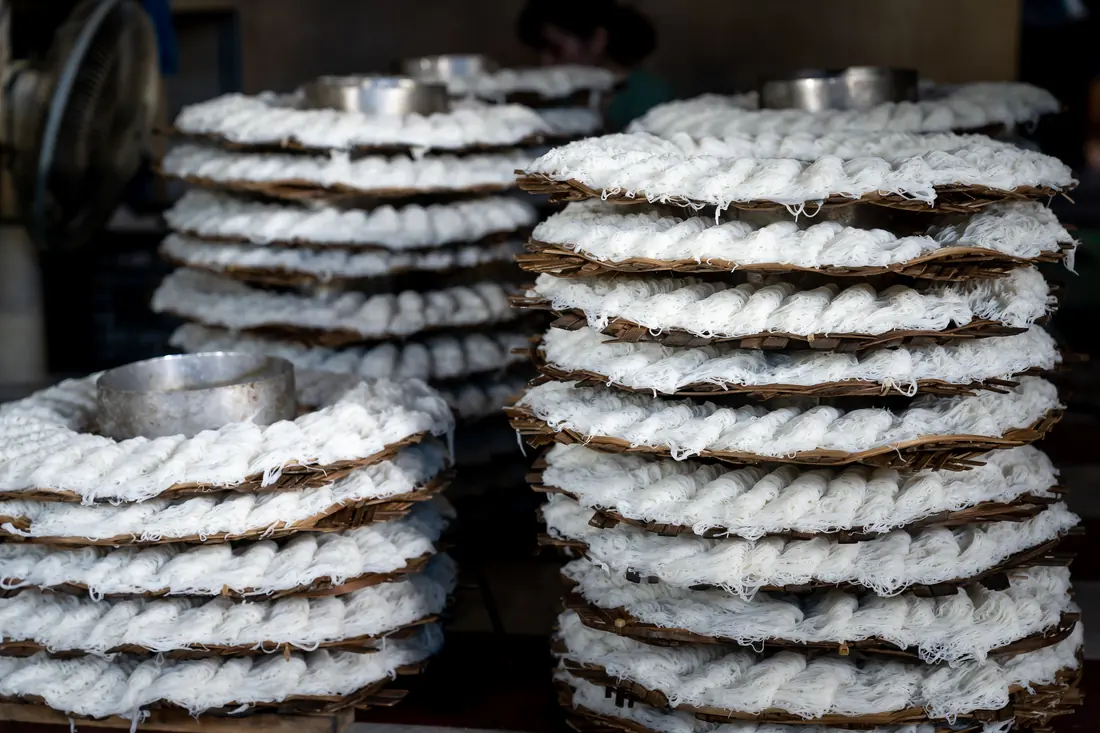
    Dried rice paper sheets stacked in a pile

    Fried appetisers behave in similar ways, so our guide to crab rangoon is worth a look if you are ordering more than one, and the takeout guide covers what holds up on the drive home. The current appetiser selection is on the ordering page.

    Frequently Asked Questions

    What is the main difference between an egg roll and a spring roll?

    The wrapper. An egg roll uses a thick wheat dough that bubbles when fried; a spring roll uses a much thinner wrapper, or rice paper if it is a fresh roll.

    Are spring rolls always fried?

    No. Fried spring rolls are crisp and served hot. Fresh spring rolls, sometimes called summer rolls, are wrapped in rice paper and served cold without frying.

    Why is it called a spring roll?

    The name refers to the season. They were eaten to mark the start of spring and filled with the first vegetables of the year.

    Which one is bigger?

    Egg rolls are the largest of the three and usually come two to an order. Fried spring rolls are smaller and come in greater numbers.

    Which is better for takeout?

    Egg rolls. The thick wrapper holds its texture longest. Thin fried spring rolls soften quickly, and fresh rolls stiffen once chilled.

  • What Comes With a Hibachi Plate?

    What Comes With a Hibachi Plate?

    Ordering hibachi is usually a two-part decision. You pick a protein, and then you are asked two or three follow-up questions in quick succession. Knowing what those questions are before they arrive makes the whole thing easier.

    What comes with a hibachi plate?

    A hibachi plate is a complete meal rather than a single dish. The protein is seared on a flat top grill and served with rice, grilled vegetables, and a choice of soup or salad to start.

    That structure is why it is such a dependable order. There is no assembling of sides and no guessing at portions – the plate arrives as a set, and the only decisions are which protein, which rice, and which starter.

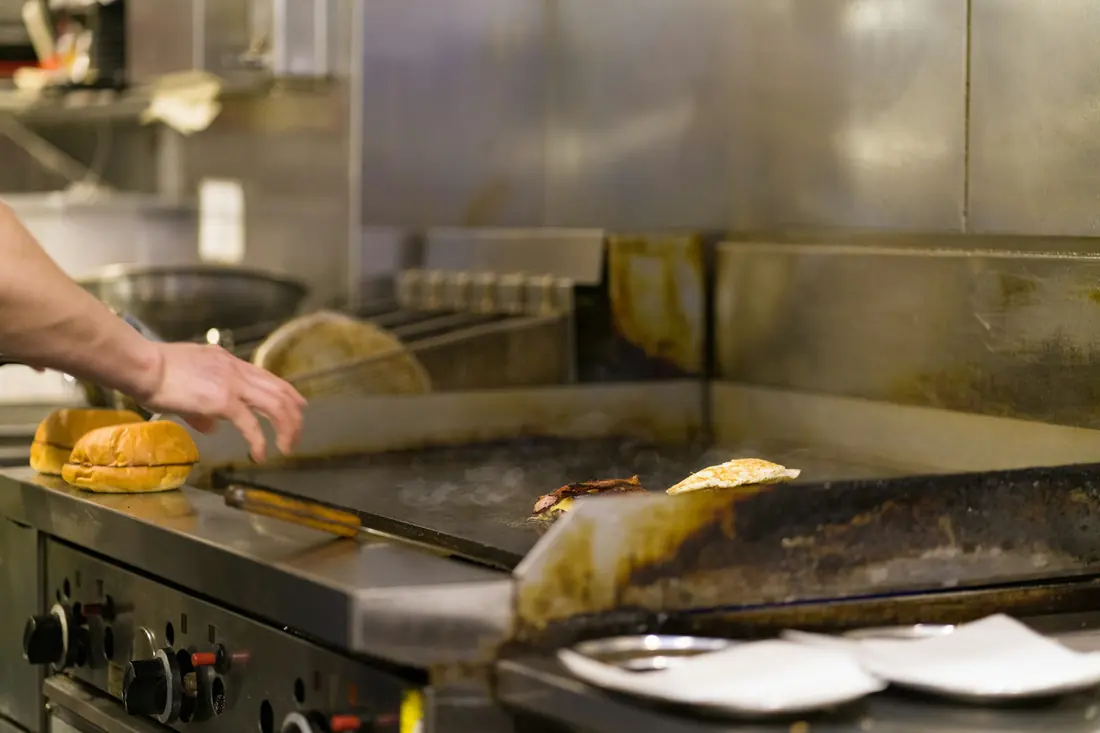
    A flat-top griddle in use in a restaurant kitchen

    The protein

    This is the first choice and the one that changes the plate most. Kitchens typically offer a range of meats alongside a vegetarian option, and some allow two proteins on a single plate.

    Cooking time is the practical difference between them. Everything is cooked to order on the same surface, so a plate does not take noticeably longer because of what you chose.

    Fried rice or steamed rice

    The second question, and the one people hesitate over most. Both are standard, and neither is an upgrade on the other.

    Fried riceSteamed rice
    CookedOn the griddle, to orderAhead, held hot
    TextureSeparate grains, slightly chewySoft and sticky
    SeasoningSeasoned as it cooksPlain
    Works well whenYou want the rice to be part of the dishYou want the sauces and protein to lead
    TravelsVery well – reheats without much lossFirms up when chilled
    Choosing between fried and steamed rice

    A simple way to decide: if you are having a heavily sauced protein, steamed rice gives it somewhere to go. If the protein is plainly seasoned, fried rice adds the flavour the plate would otherwise be missing.

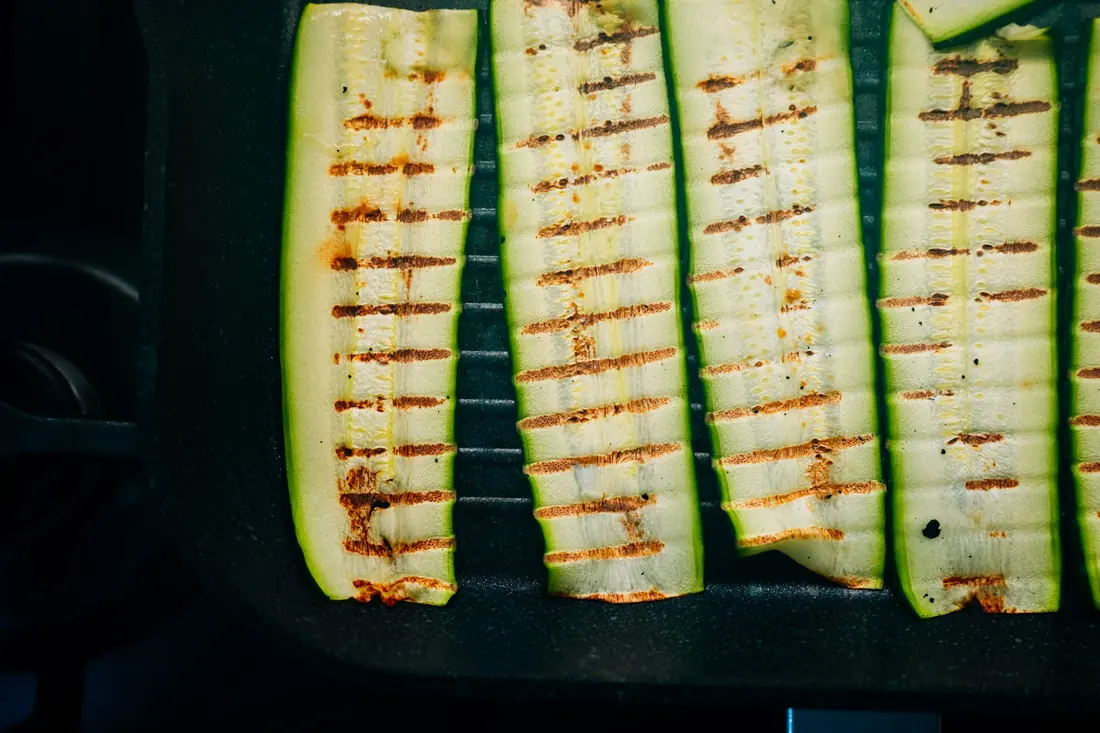
    Sliced zucchini grilled until marked

    Why it is cooked on a flat surface

    The whole plate depends on the griddle, and the reason is contact. A flat steel surface touches every part of what sits on it, so heat moves into the food quickly and evenly instead of only where it meets a bar.

    That matters most for the things that would fall through a grate. Rice, small vegetable pieces and thinly cut protein all need a solid surface, and all three are on a hibachi plate.

    It also means everything can be cooked in the same place at the same time, which is why the components arrive together and equally hot rather than in the order they were started.

    The vegetables

    Grilled vegetables come as part of the plate rather than as a side you choose. What appears varies with what the kitchen has, but the treatment is consistent – cut into pieces that cook quickly, seared hard on the flat top, and seasoned simply.

    Zucchini, onion, carrot and mushroom are the usual suspects, because all four hold their shape at high heat and pick up colour quickly. The searing is the point: it concentrates the flavour rather than softening it.

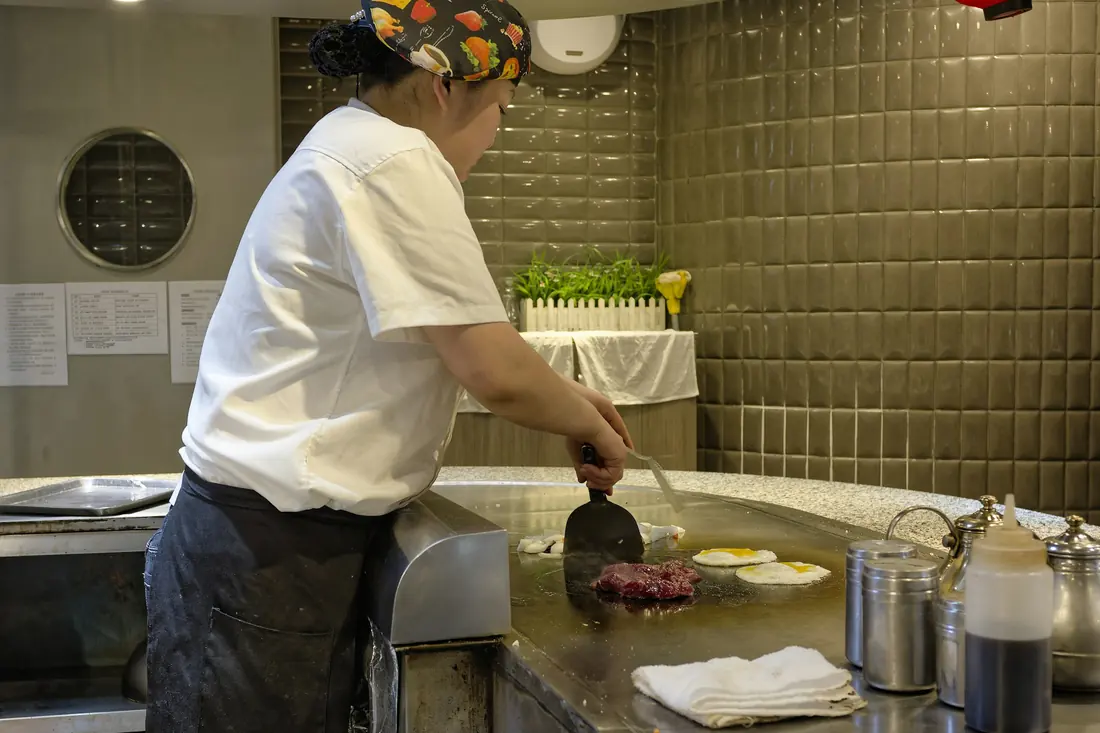
    A chef cooking on a flat teppan grill

    A small thing worth asking about: some kitchens will put both proteins and both rices on one plate if you ask, and some will not. It costs nothing to ask, and it is the easiest way to try two things on a first visit without ordering twice.

    Soup or salad

    The starter choice arrives before everything else, and it is a genuine fork in the road rather than a formality.

    • Miso soup – a light savoury broth made from fermented soybean paste, usually with tofu and seaweed in it. Britannica’s entry on miso covers where the paste itself comes from.
    • Onion soup – a clear broth, typically with fried onions, mushrooms and scallions.
    • Salad – a small plate of leaves with a dressing, served cold.

    The salad is the better choice if the rest of your order is hot and heavy, because it resets the palate. The soup is better on a cold evening or when you are waiting for a table’s worth of food to arrive together.

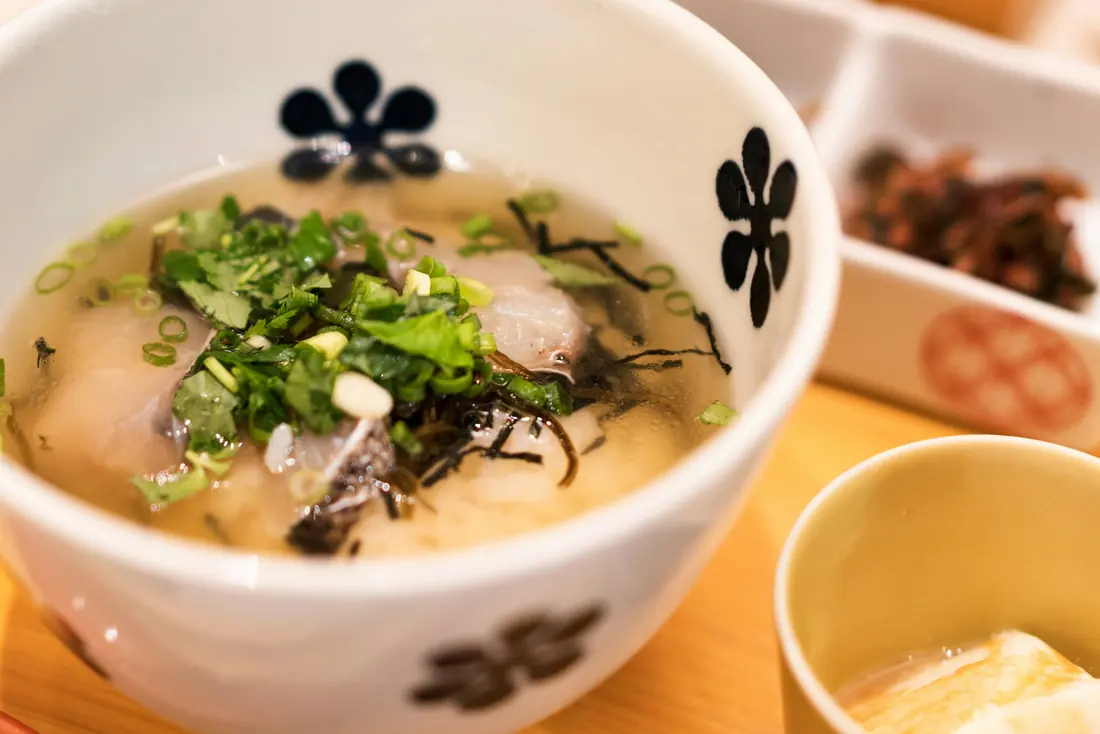
    A bowl of miso soup

    The sauces

    Most kitchens send one or two sauces with the plate. A pale, thick, mildly sweet sauce is near-universal; a thinner, darker, saltier one often comes alongside it.

    Use them sparingly at first. The protein and vegetables are already seasoned on the grill, and the sauces are designed to accent rather than coat. It is easy to add more and impossible to take it back off.

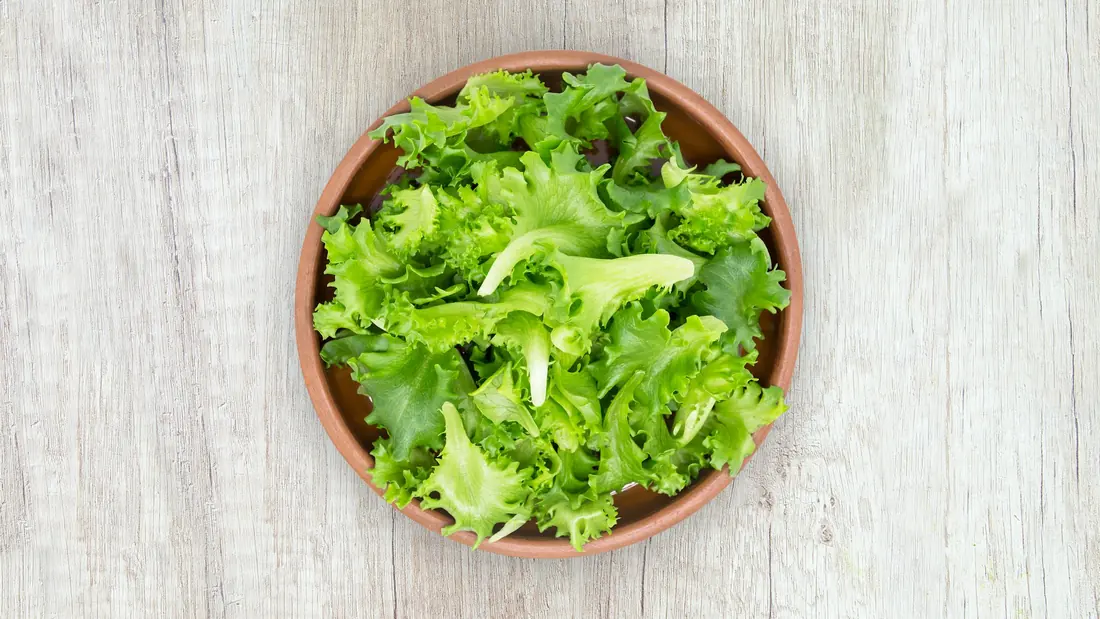
    A simple green salad in a bowl

    How the plate is timed

    From the kitchen’s side the order runs backwards from what you might expect. The starter goes out immediately, because it is already made. The rice is started next, since it takes the longest on the griddle.

    The vegetables follow, then the protein, which is usually the quickest thing on the plate and is cooked last so it is not sitting while everything else finishes.

    This is worth knowing if you are ordering with a group. Adding one more plate does not delay the table much, because the griddle is already hot and running, but adding fried appetisers partway through the meal usually does.

    How much food it actually is

    A hibachi plate is generous by design. Between the protein, a full portion of rice and the vegetables, it is comfortably a full meal for one person, and the starter sits on top of that.

    This matters when ordering for a group. Two plates and something to share often feeds three people more comfortably than three plates, particularly if anyone is also ordering rolls.

    Ordering it for a child

    Hibachi is one of the easier things on an Asian restaurant menu to order for a child, largely because it is recognisable. Grilled protein, rice and vegetables on one plate needs no explanation.

    Two adjustments make it simpler still: ask for the sauces on the side rather than on the plate, and choose steamed rice, which is plainer than the seasoned fried version. Between them, that removes almost everything a cautious eater might object to.

    Ordering it to take away

    Hibachi is one of the better things to order for eating at home. Grilled protein and rice hold their texture on the drive and reheat the next day without much loss, which is not true of most fried food.

    Two small adjustments help. Ask for the sauces separately if that is an option, so the rice does not sit in them, and choose fried rice over steamed if the meal is going to be reheated rather than eaten straight away.

    If you are still deciding whether hibachi is the right order at all, our guide to what hibachi actually means explains the grill it is named after, the soup comparison goes further into the starter choice, and the three-way comparison helps if a table cannot agree. The current selection is on the ordering page.

    Frequently Asked Questions

    Does a hibachi plate come with rice?

    Yes. Rice is part of the plate rather than a side you add, and you are normally asked whether you want it fried or steamed.

    What is the difference between the soup and the salad option?

    The soup is hot and savoury – miso is a soybean paste broth, onion soup is a clear broth with fried onions and mushrooms. The salad is a cold plate of leaves with dressing. You choose one, not both.

    Can you order hibachi without meat?

    Vegetarian options are a standard part of how hibachi is served. What is available varies by kitchen, so it is worth checking when you order.

    Is fried rice or steamed rice better with hibachi?

    Neither is better. Fried rice is seasoned and cooked to order; steamed rice is plain and lets sauces lead. Choose steamed if your protein is heavily sauced.

    Is a hibachi plate enough for two people?

    It is built as a single meal, but it is a generous one. Two plates plus something shared usually suits three people better than three plates.

  • What Is Imitation Crab? Surimi Explained

    What Is Imitation Crab? Surimi Explained

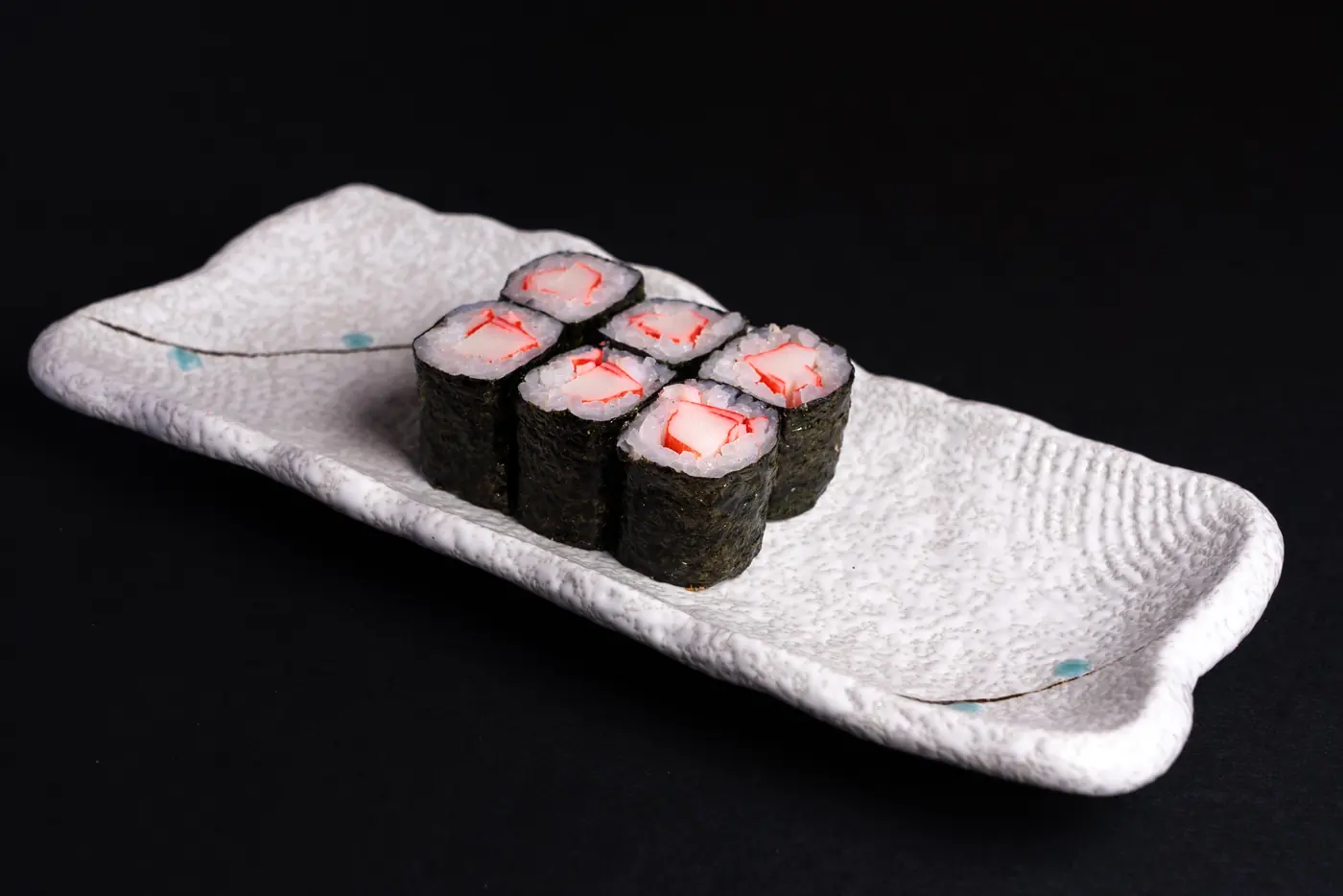
    Read a sushi menu closely and the phrase “crab mix” turns up again and again. It is in the roll descriptions, it is in the salads, and it is almost never explained. Most of the time what it means is imitation crab.

    What is imitation crab?

    Imitation crab is a fish product shaped and coloured to resemble crab meat. The proper name for it is surimi, a Japanese term for white fish that has been minced, rinsed and worked into a smooth paste, then bound, formed and lightly cooked.

    It is not a modern shortcut. Surimi has been made in Japan for centuries as a way of turning plentiful white fish into something that keeps and travels. The crab-shaped version most people recognise dates from the 1970s.

    Cut sushi rolls arranged on a white plate

    What it is actually made from

    The base is white fish. Alaska pollock is the most common choice by a wide margin, because it is mild, pale and caught at scale; NOAA Fisheries’ profile of Alaska pollock gives a sense of how large that fishery is.

    From there the process is mechanical rather than mysterious. The fish is minced and washed repeatedly until what remains is close to flavourless, then worked with starch and seasoning into a firm paste that can be shaped.

    The red edge is added last. It is a surface colouring only, which is why a crab stick is white when you pull it apart, and why the red rubs off slightly on your fingers.

    Fish fillets laid out on ice at a market counter

    Why it tastes the way it does

    The washing stage is the reason imitation crab tastes clean and slightly sweet rather than fishy. Nearly everything that would read as “fish” is rinsed out before the paste is seasoned.

    What replaces it is a mild savoury seasoning built to suggest shellfish. The result is deliberately simple, and that simplicity is exactly why it works inside a roll, where it sits alongside rice, avocado, cucumber and sauce without fighting any of them.

    Shredded seafood salad dressed in a bowl

    The shapes it comes in

    Surimi is sold in several forms, and which one a kitchen buys tells you something about how it will be used.

    • Sticks – the familiar rectangular batons, used whole in hand rolls and cut into lengths for cut rolls.
    • Flakes – short irregular pieces, mixed with a dressing to make the crab salad that fills so many rolls.
    • Shreds – long fine strands, used where the filling needs to pack tightly without lumps.
    • Chunks – larger pieces shaped to imitate leg meat, used where the crab is meant to be visible on top.

    The differences are mechanical rather than culinary. All four are the same product formed differently, and a kitchen chooses between them based on what the dish needs to hold together.

    Imitation crab and real crab compared

    Imitation crab (surimi)Crab meat
    Made fromMinced white fish, usually pollockCrab
    TextureFirm, even, slightly springyLoose flakes of varying size
    FlavourMild and faintly sweetDistinctly shellfish
    FormSticks, flakes or shredsPicked meat, lump or claw
    Typical useRolls, salads, fillingsServed on its own or lightly dressed
    On a menu“crab mix”, “crab stick”, “krab”“crab”, named by cut
    How surimi differs from crab meat

    The spelling is worth noticing. Some restaurants write “krab” with a K specifically to signal the difference, and where a kitchen does that it is being helpful rather than coy.

    Where it shows up on a sushi menu

    Once you know the term, the pattern is easy to read.

    • Classic rolls – the standard combination of crab mix, avocado and cucumber is built on it.
    • Specialty rolls – crab mix is frequently the base layer under a topping of fish, because it holds its shape when the roll is cut.
    • Salads – shredded and dressed, served cold.
    • Hand rolls – where its firmness stops the filling collapsing.

    If you want to know which one a particular dish uses, the reliable move is simply to ask. Kitchens answer this question constantly and nobody finds it odd.

    A bamboo rolling mat used for making sushi

    Where else it turns up

    Sushi is where most people meet it, but it is not confined there. Cold seafood salads are frequently built on it, as are the fillings in a number of hot dishes where a firm, mild seafood texture is wanted.

    It travels well beyond Japanese cooking too. Surimi products appear in soups and stews across East and Southeast Asia in the form of fish cakes and fish balls, which are made by the same washing-and-binding process without the crab shaping.

    The through-line is convenience of a specific kind: a seafood ingredient that is mild, keeps well, and behaves predictably under heat and under a knife.

    Is it worse than crab?

    It is different rather than worse, and treating it as a substitute misses what it is good at. Crab meat is delicate and comes apart; surimi holds together under a knife, which is the entire reason it ended up inside rolls.

    A roll built on crab meat would fall apart when sliced and the flavour would be lost under the rice and sauce anyway. The imitation version was not chosen to save money alone. It behaves better in the format.

    Where real crab makes sense is when it is the point of the dish rather than a component of one, served plainly enough that you can taste it.

    A chilled seafood counter stocked with shellfish

    The names it goes by

    Very little of what surimi is sold under uses the word surimi, which is part of why it stays unexplained. On menus and packaging you will see crab stick, crab mix, seafood stick, ocean stick, and the deliberate misspelling krab.

    In Japanese it is usually kanikama, a contraction of the words for crab and for the fish-cake family it belongs to. That name is the most honest of the lot, since it says plainly that the thing is a fish cake in the shape of crab.

    How to tell them apart on the plate

    1. Look at the edges. A uniform red or orange line along one side means surimi.
    2. Pull a piece apart. Surimi separates into long even strands; crab meat breaks into irregular flakes.
    3. Check the shape. Perfectly rectangular sticks or evenly shredded strands are manufactured.
    4. Taste for sweetness. Surimi is mild and slightly sweet; crab is unmistakably shellfish.

    None of this matters much when it is inside a roll. It matters when a dish is built around crab and you want to know which one you are getting.

    Rolls are where most people meet it, so if you are still working out how the different styles fit together, our guide to sushi rolls for beginners covers the basic construction, and the specialty rolls guide explains why house rolls are built in layers. You can see the current selection on the ordering page.

    Frequently Asked Questions

    Is there any real crab in imitation crab?

    Usually none at all. It is made from white fish, most often pollock, with seasoning and a surface colouring. Some products include a small amount of crab extract for flavour, but the substance of it is fish.

    What does surimi mean?

    It is the Japanese term for minced, washed fish paste. Imitation crab is one product made from surimi; fish cakes and fish balls are others.

    Why is it used in sushi rolls instead of crab?

    It holds its shape when a roll is sliced, and its mild flavour sits comfortably under rice, avocado and sauce. Crab meat would break up and largely disappear.

    Is imitation crab cooked?

    Yes. The paste is cooked as part of forming it, so what arrives has already been through heat. That is why rolls built on crab mix are described as cooked rolls.

    How can I tell if a roll uses it?

    Look for “crab mix”, “crab stick” or “krab” in the description, and look for the red-edged white strands in the cut face of the roll. If it is not clear, ask.

  • What Is Tofu? Silken and Firm, Explained

    What Is Tofu? Silken and Firm, Explained

    Tofu turns up in the miso soup at almost every Japanese restaurant, usually as small pale cubes that people either enjoy or push to the side. It is one of the oldest prepared foods in East Asia and one of the most misunderstood.

    What is tofu?

    Tofu is made by curdling soy milk and pressing the curds into a block — much the same process as making fresh cheese, but with soybeans instead of dairy. How hard it is pressed determines whether it comes out silken and custardy or firm enough to fry.

    Dried soybeans in a bowl

    A short history

    Tofu originated in China and spread through East and Southeast Asia over many centuries, arriving in Japan roughly a thousand years ago. It became closely tied to Buddhist temple cooking there, where meat was avoided and tofu supplied both substance and protein.

    That history is why Japanese tofu dishes tend toward restraint rather than heavy seasoning. The tradition treats a good block of tofu as something to be shown off plainly — chilled with a little soy and ginger, or floated in a clear broth — rather than disguised.

    The version most people first encounter in a restaurant, small cubes in miso soup, sits squarely in that tradition. It is not trying to be the centre of the dish.

    How it is made

    1. Dried soybeans are soaked and ground with water.
    2. The mixture is cooked and strained to produce soy milk.
    3. A coagulant is added, and the milk separates into curds and whey.
    4. The curds are pressed. Light pressing gives silken tofu; heavy pressing gives firm.
    Soy milk being poured from a jug

    Britannica’s entry on tofu traces the food back roughly two thousand years in China, from where it spread across East and Southeast Asia and developed distinct regional styles.

    Soft tofu cubes floating in a clear broth

    Silken, soft and firm

    The type used changes the dish completely, which is why tofu in a soup bears little resemblance to tofu in a stir-fry.

    TypeTextureTypically used for
    SilkenCustardy, breaks easilySoups, chilled dishes, blended sauces
    SoftDelicate but holds a cubeMiso soup, simmered dishes
    FirmSpringy, holds its shapeStir-fries, grilling, pan-frying
    Extra firmDense and chewyFrying, skewering, roasting
    Fried tofuCrisp outside, airy insideToppings, broths, appetisers
    The main types and where each is used.

    Why it tastes of almost nothing

    This is the most common complaint and it is entirely accurate. Plain tofu is mild by design — its job is to carry the flavour of whatever it is cooked in, in the same way pasta or rice does.

    Firm tofu being sliced on a board

    That is why tofu in a well-made miso soup tastes of the broth, and why tofu that has been fried or marinated tastes strongly of the treatment rather than of soy. If you have only had it plain and cold, you have had it at its least interesting.

    What it does in a dish

    Tofu is usually doing one of three jobs, and knowing which explains why the same ingredient can seem completely different from one plate to the next.

    • Carrying flavour — in a broth, where it soaks up the surrounding seasoning and adds softness without competing.
    • Providing texture — fried or grilled, where the contrast between a crisp exterior and an airy interior is the whole point.
    • Adding body — blended into sauces and dressings, where it thickens without dairy.

    Almost every complaint about tofu comes from meeting it in the first role and assuming that is all it does. Soft cubes in a clear broth are the least assertive form of the ingredient, which is exactly why they are used there.

    Why texture varies so much

    Two blocks of tofu can come from the same soy milk and behave completely differently, and the reason is pressing. The longer a curd is drained and weighted, the more water leaves it and the denser what remains becomes.

    That single variable explains most of what you notice on the plate. A barely pressed block collapses under a spoon and is used where softness is wanted. A heavily pressed one holds a cube shape through frying, grilling and stirring, which is why it turns up wherever the tofu has to survive some handling.

    Nothing is added or removed to achieve this. It is the same ingredient at different stages of the same process.

    Where you will meet it on a Japanese menu

    The most common encounter by far is in miso soup, where soft or silken cubes sit in the broth alongside seaweed. Roll & Go Sushi’s miso soup follows that standard pattern — soybean paste broth with seaweed and tofu.

    Because the cubes are small and the broth is savoury, this is a low-commitment way to find out whether you like the texture. Our comparison of the two starter soups covers what else is in the bowl.

    Cubes of tofu pan-fried until golden at the edges

    Forms you might not recognise as tofu

    Several things on a Japanese menu are tofu without looking remotely like the white cubes most people picture.

    • Aburaage — thin sheets fried until they puff and turn golden. These are the pouches used for inari, and the strips that float in some miso soups.
    • Atsuage — a thicker block fried on the outside only, so it has a firm skin and a soft centre.
    • Yuba — the delicate skin that forms on the surface of heated soy milk and is lifted off in sheets. Silky rather than solid.
    • Koyadofu — freeze-dried tofu, spongy and absorbent once rehydrated in broth.

    If plain tofu has never appealed, these are the versions most likely to change your mind, because texture rather than mildness is the point of all four.

    If you have not enjoyed it before

    Texture is almost always the reason, and the fix is usually a firmer type or a different cooking method rather than giving up on it.

    • Disliked it in soup? Try it fried, where the outside is crisp and the inside is airy rather than soft.
    • Found it bland? That is the point — look for it in dishes where it has been marinated or browned.
    • Disliked the sliminess? That is silken tofu. Firm tofu is a completely different texture.

    It is also easy to eat around. In a miso soup the tofu is a component rather than the dish, and leaving it does not spoil the rest of the bowl.

    Buying and keeping it

    Fresh tofu is sold packed in water and should stay that way. Once the packet is opened, the usual approach is to keep it submerged in fresh water in the fridge and change the water daily, which holds it for a few days rather than a few hours.

    Shelf-stable tofu in sealed cartons is a different product. It keeps unopened for months and is almost always silken, which makes it useful for blending and poor for frying.

    Firmness can also be adjusted after purchase. Pressing a block under weight for half an hour drives out water and moves a soft tofu closer to a firm one, which is the usual fix if you have bought the wrong type for what you are cooking.

    A note on dietary assumptions

    Tofu is made from soybeans, so it is a soy product and unsuitable for anyone avoiding soy. Beyond that, do not assume a dish is vegetarian simply because it contains tofu — miso soup, for instance, is frequently built on a fish-based stock.

    If you are avoiding a specific ingredient, ask the restaurant about the broth rather than inferring from the visible components.

    Frequently Asked Questions

    Is tofu the same as bean curd?

    Yes. Bean curd is the older English name for the same food, and both terms appear on menus.

    Why is the tofu in miso soup so soft?

    Soups normally use soft or silken tofu, which is only lightly pressed. Firmer types would sit awkwardly in a delicate broth.
    Does tofu have a strong taste?

    No, and that is deliberate. It is mild by design and takes on the flavour of the broth, marinade or sauce it is cooked with.

    Is a dish vegetarian because it contains tofu?

    Not necessarily. Many broths are made with fish-based stock. Ask the restaurant rather than assuming.

    Curdled soy milk, pressed to different densities, doing a different job in each dish. If soup tofu has never appealed, the fried version is a completely different experience.

    You can see the current soup options or read about the larger noodle soup on the menu.

  • Restaurant Sushi vs Grocery Store Sushi

    Restaurant Sushi vs Grocery Store Sushi

    Supermarket sushi has got considerably better over the past decade, which makes the comparison a real one rather than an obvious win for restaurants. The differences are mostly about time rather than skill.

    The short answer

    Both are regulated and both can be perfectly safe. The difference is freshness: restaurant sushi is made to order and eaten within minutes, while packaged sushi is assembled in advance and refrigerated, which hardens the rice and mutes the fish. Buy packaged sushi the day it was made, and eat it the same day.

    A chef shaping sushi rice by hand

    Why refrigeration is the deciding factor

    Sushi rice is seasoned and served at close to room temperature for a reason. Chilling it causes the starch to firm up, which is why supermarket rice tends to be denser and drier than rice from a counter.

    The same applies to the fish, whose texture and aroma both flatten when cold. None of this is a safety issue — refrigeration is exactly what keeps packaged sushi safe — it is simply the trade-off that makes the product possible.

    A sealed plastic tray of pre-made sushi

    What each does well

    Restaurant sushiPackaged supermarket sushi
    MadeTo orderIn advance, often off-site
    Rice textureSoft, close to room temperatureFirmer from chilling
    RangeFull menu, including specialty rollsA small fixed selection
    CustomisationYes — substitutions and requestsNone
    ConvenienceRequires a visit or an orderGrab and go
    CostHigherLower
    Best eatenImmediatelySame day, as soon as possible
    Where each option genuinely wins.
    Freshly made sushi presented on a wooden board

    Safety is mostly about handling

    Packaged sushi sold in the United States is subject to the same food-safety framework as other prepared retail food, and reputable producers hold to it. The risks that do exist come from temperature and time rather than from the format.

    The FDA’s guidance on safe food handling covers the general principles — keeping cold food cold, and not leaving prepared food at room temperature. Both matter more for packaged sushi than for a plate that was made ninety seconds ago.

    • Check the date. Same-day is the standard to aim for.
    • Buy it cold and get it home cold. A long warm car journey undoes the chilling the shop has maintained.
    • Do not keep leftovers overnight, particularly anything with raw fish.
    • Look at it. Fish should look moist rather than dull or dry, and rice should look plump rather than cracked.

    What changed in supermarket sushi

    A decade ago the comparison was not close. What shifted is mostly logistics: in-store counters preparing rolls on site, shorter supply chains, and better packaging that holds humidity around the rice instead of drying it out.

    Some stores now assemble on the premises through the day rather than receiving a single delivery each morning. Where that is happening, the freshness gap narrows considerably, and the remaining difference is range rather than quality.

    It is still worth checking which model a shop uses. A counter with someone visibly making rolls is a different product from a chilled shelf stocked once a day, even though both sit under the same heading.

    What survives packaging and what does not

    The gap between the two is far wider for some items than others, and knowing which is which makes the choice straightforward.

    • Travels well — cucumber, avocado and other vegetable rolls, and simple cooked rolls. Little to lose in the first few hours.
    • Travels adequately — cooked rolls with a crab or shrimp filling, provided the rice has not been over-chilled.
    • Travels badly — anything with tempura in it, which softens within minutes, and anything dressed with a sauce that soaks into the rice.
    • Does not travel — hand rolls, which depend on nori that has just been folded.

    This is why packaged ranges skew heavily toward the first two groups. It is a sensible response to the format rather than a limitation of the shop.

    When packaged sushi is the right answer

    It genuinely is sometimes. A supermarket tray at lunchtime, eaten within the hour, is a reasonable meal and does not pretend to be anything else.

    Chilled shelves in a grocery store

    It is also the more sensible option when the alternative is sushi that has to travel a long way. A packaged roll designed to be eaten cold beats a restaurant roll that has spent forty minutes in a delivery bag.

    When it is worth going to a restaurant

    Anything raw, anything fried and anything with a sauce is worth eating where it was made. Those three categories all lose the most in the gap between kitchen and table, and they are also where a kitchen’s own decisions show most.

    The other reason is range. Packaged selections stick to a handful of reliable, well-travelling rolls. A restaurant menu carries the specialty rolls, which are the ones built with toppings and finishing sauces that do not survive packaging.

    A shopper choosing items in a grocery aisle

    Roll & Go Sushi is a fast casual kitchen, which sits usefully between the two — made to order, but quick enough to collect and eat straight away. Our guide to pickup versus delivery covers how to keep it at its best on the way home.

    Reading a packaged label

    Two lines on the label tell you most of what matters, and both are easy to miss.

    • The made-on or use-by date. Same-day is what you want. A tray dated yesterday may still be within its window but will have lost the most in rice texture.
    • The ingredient list for the fish. Terms like “seafood blend” or “surimi” indicate imitation crab rather than crab, which is not a problem but is worth knowing.

    Beyond that, trust what you can see. Rice that looks cracked or translucent has been chilled too long, and fish that has dried at the edges will taste like it.

    Takeout sits between the two

    There is a third option that the usual comparison leaves out. Ordering from a restaurant to eat at home gives you the made-to-order preparation and the full menu, with a short delay rather than a full day of refrigeration.

    Most of the freshness advantage survives that trip. Rice made an hour ago is still close to its best, and the items that suffer are the same ones that suffer in a packaged tray — tempura and anything folded rather than cut. Ordering around them closes most of the gap.

    If the question is really about eating at home rather than about cost, this is usually the better answer than either side of the comparison.

    A quick way to decide

    1. Are you eating within fifteen minutes? If yes, either works.
    2. Do you want raw fish, tempura, or a sauced specialty roll? Go to the restaurant.
    3. Is it a weekday lunch you will eat at your desk shortly? Packaged is fine.
    4. Has the packaged tray got today’s date on it? If not, choose something else.

    The cost difference, honestly

    Packaged sushi is cheaper, and the reasons are structural rather than a matter of corner-cutting. Production runs are larger, the labour is spread across many trays rather than one order, and there is no table service attached to the price.

    A restaurant is selling something different: made-to-order preparation, a full menu including items that cannot be packaged, and the option to ask for changes. Whether that is worth the difference depends entirely on what you want from the meal.

    For a quick lunch eaten within the hour, the cheaper option is genuinely adequate. For anything you are looking forward to, the gap is easy to justify.

    Frequently Asked Questions

    Is grocery store sushi safe to eat?

    Generally yes, when it has been kept properly chilled and is eaten by its date. The usual advice is to buy it the day it was made and eat it the same day.

    Why does supermarket sushi rice taste different?

    Refrigeration firms up the starch in the rice, making it denser and drier than rice served near room temperature at a counter.

    Can you keep leftover packaged sushi overnight?

    It is not recommended, particularly with raw fish. Quality drops sharply and it is not worth the risk.

    Is restaurant sushi always better?

    Not automatically, but it has the advantage of being made to order. For fried, raw or sauced items the difference is significant.

    Packaged sushi is a convenience product and a decent one. Restaurant sushi is a different thing being sold, and the gap shows most in the items that depend on being eaten immediately.

    If you want something made to order, see what is on the menu, or read our guide to which rolls travel well.

  • Soy Sauce, Wasabi and Ginger: How to Use Them

    Soy Sauce, Wasabi and Ginger: How to Use Them

    Three things arrive alongside almost every sushi order: a bottle of soy sauce, a small green mound, and a pile of pink slices. Most people use at least one of them wrongly, and the pink one is routinely eaten at the wrong moment entirely.

    What each one is for

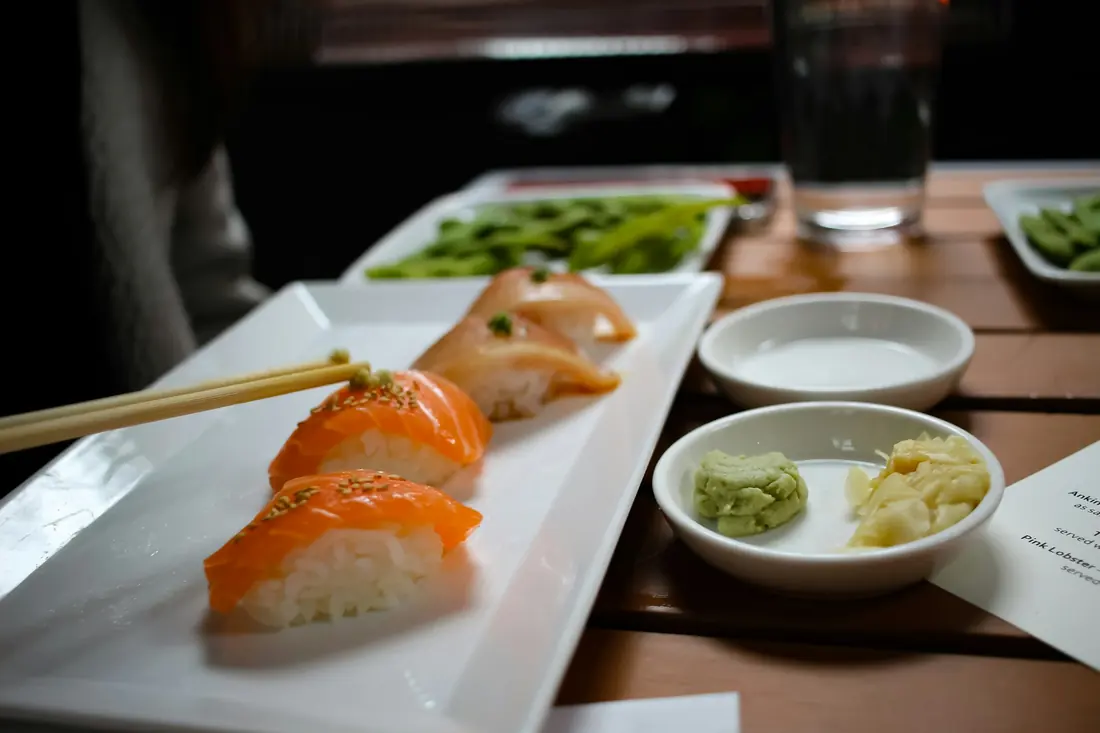
    Soy sauce is for dipping, sparingly, fish-side down. The green paste is wasabi, a seasoning already present inside most nigiri. The pink slices are pickled ginger, eaten between pieces to reset your palate — not piled on top of the sushi.

    Fresh wasabi rhizomes growing

    Soy sauce

    The single most common mistake is soaking the rice. Sushi rice is seasoned and loosely packed; saturate it and it both falls apart and overwhelms whatever it was wrapped around.

    Pour a small amount into the dish — far less than feels right — and dip the fish side rather than the rice side. For a cut roll, a light touch on one edge is enough.

    A small mound of green paste served beside sushi

    Rolls finished with their own sauce need none at all. If a roll arrives with a drizzle across the top, the kitchen has already seasoned it, and adding soy on top of that is doubling up.

    Wasabi

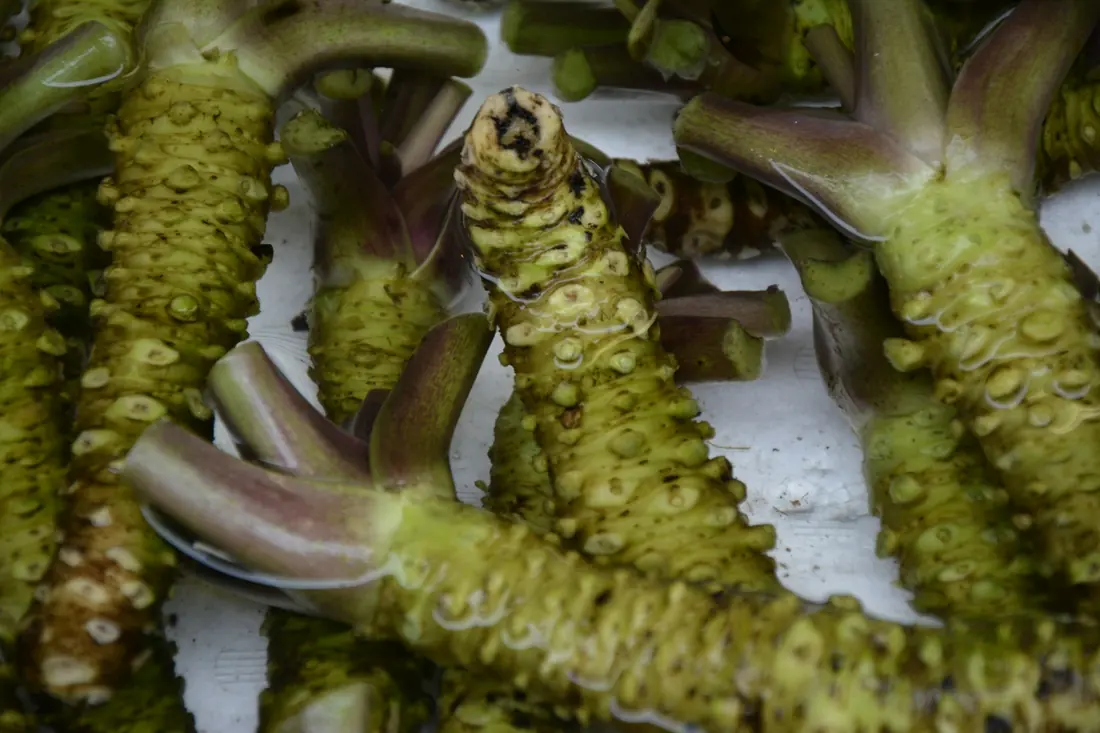
    Real wasabi is the grated rhizome of a plant grown in cold running water. It is difficult to cultivate and loses its aroma within minutes of being grated, which is why very few restaurants anywhere serve it.

    Thin slices of pink pickled ginger

    What arrives on most plates is a blend based on horseradish, mustard and colouring. It is sharper and more persistent than the real thing, which is milder and more aromatic. Britannica’s entry on wasabi covers the plant itself and why it is so rarely used fresh.

    Either way, the heat is volatile — it hits the nose rather than the tongue and fades quickly, unlike chilli. That is also why mixing it into a dish of soy sauce dulls it almost immediately.

    Pickled ginger

    Known as gari, this is thinly sliced young ginger pickled in vinegar and sugar. The pink colour is sometimes natural to young ginger and often added.

    Soy sauce being poured into a shallow dipping dish

    It is a palate cleanser, taken between pieces so that one roll does not bleed into the next. Eating it on top of a piece of sushi buries whatever you were about to taste, which defeats its purpose entirely.

    The three compared

    Soy sauceWasabiPickled ginger
    What it isFermented soybean and wheat seasoningGrated rhizome, or a horseradish blendYoung ginger pickled in vinegar
    PurposeSalt and depthAromatic heatResets the palate
    When to use itAs you eat each pieceSparingly, or not at allBetween pieces
    Common mistakeSoaking the riceStirring it into soy sauceEating it on top of the sushi
    Already in the dish?Sometimes, as a glazeOften, inside nigiriNo
    What the three condiments are for and how they are misused.
    What else turns up on the table

    Beyond the three, a few other items appear often enough to be worth recognising.

    • A small shallow dish — for soy sauce, and deliberately shallow so you cannot pour much into it.
    • A chopstick rest — chopsticks go across it between bites rather than on the table or upright in food.
    • A hot towel — for your hands before eating, particularly relevant where hand rolls or nigiri are on the table.
    • Green tea — served throughout rather than at the end, and traditionally the drink that accompanies sushi.

    None of it is compulsory and no restaurant expects a performance. Knowing what the items are for simply removes the guesswork.

    What they are called on a Japanese menu

    The names turn up often enough on menus and in restaurants that they are worth recognising, even though nobody expects you to use them.

    • Shoyu — soy sauce. The word covers a family of styles rather than one product, which is why the flavour differs from restaurant to restaurant.
    • Gari — the pickled ginger. Sliced thin and pickled in sweetened vinegar, which is where both the sharpness and the pale pink come from.
    • Wasabi — the green paste, whether it is the true rhizome or the more common horseradish-based version.

    You will also see oroshi for grated daikon and ponzu for a citrus-soy sauce, both of which turn up beside cooked dishes more often than beside sushi.

    Mixing wasabi into soy sauce

    This is the practice that draws the most comment, and the objection is practical rather than ceremonial. Wasabi’s aroma is volatile; dissolved into liquid it disperses and flattens, so you get salt where you wanted sharpness.

    If you want heat, a small amount placed directly on the fish keeps it where you can taste it. Nobody will mind if you mix it — but the result is genuinely less good, which is a better reason than tradition.

    A piece of sushi held with chopsticks above a dish of soy sauce

    Why it varies so much between restaurants

    Condiment quality is one of the least visible differences between sushi restaurants and one of the most noticeable once you pay attention to it. Soy sauces differ considerably in salt and sweetness, and some kitchens dilute or blend their own.

    Pickled ginger varies just as much — thickness of slice, sharpness of the pickle, and how much sugar is in it. A thin, sharp ginger does its job; a thick, sweet one competes with the food it was meant to clear.

    Because these are supplied rather than made in most kitchens, they tell you something about how much attention the restaurant pays to details the customer rarely comments on.

    The sauces that are not condiments

    A second group of sauces appears on the rolls themselves rather than on the table, and they change how you should treat the three classics.

    Spicy mayonnaise, the sweet dark glaze often labelled eel sauce, and the various house drizzles on specialty rolls are all applied in the kitchen as part of the dish. They are seasoned to work on their own.

    That is the practical reason a heavily dressed roll rarely needs soy sauce. Adding it stacks salt on salt and flattens whatever the glaze was doing. Save the soy dish for the plain rolls and the nigiri on the same plate.

    When to skip them entirely

    Plenty of rolls need nothing added. Anything already sauced, anything with a strong topping, and most tempura rolls are seasoned to be eaten as served.
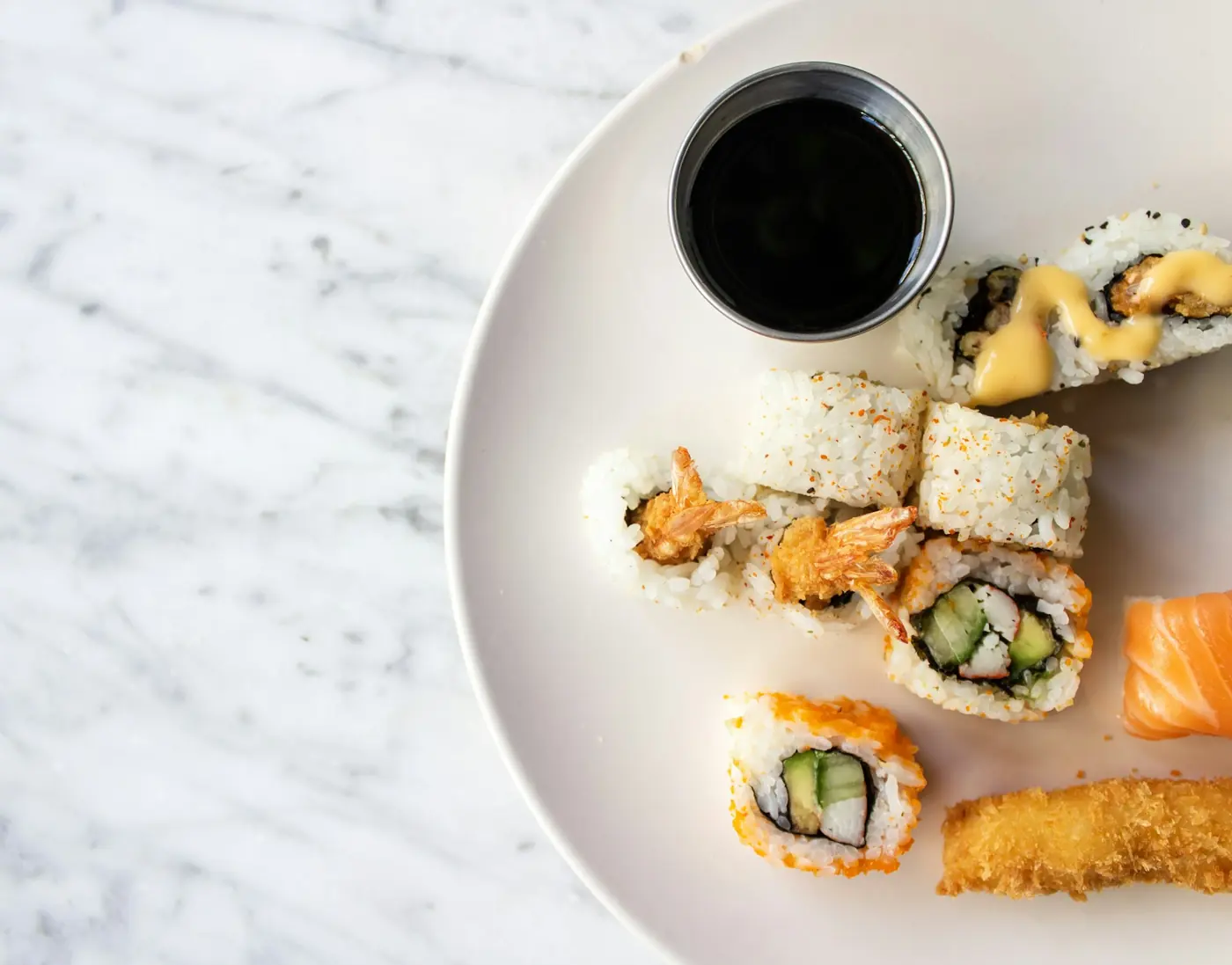
    A useful habit is to taste the first piece with nothing at all. It tells you whether the roll needs anything, and quite often it does not — particularly with specialty rolls, which are usually built with their finishing sauce as an integral part rather than an optional extra. Our guide to how specialty rolls are constructed covers why.
    How much of each to use

    Rough proportions help more than rules. For a six-piece roll, a teaspoon of soy sauce in the dish is plenty, and most people pour four or five times that.

    Wasabi, if you are adding it at all, means a smear roughly the size of a grain of rice per piece — enough to notice, not enough to overwhelm. And one or two slices of ginger between rolls, rather than a mouthful.

    The underlying principle is that all three are seasonings rather than ingredients. If you can taste the condiment more clearly than the fish, the balance has tipped, and the fish is usually the more expensive part of what you ordered.

    Frequently Asked Questions

    Is the wasabi at most restaurants real?

    Usually not. Most is a horseradish-based blend, because real wasabi is difficult to grow and loses its aroma within minutes of grating.

    Should you mix wasabi into soy sauce?

    It is common, but it dulls the wasabi. A small amount placed directly on the fish keeps the aroma where you can taste it.

    When do you eat the pickled ginger?

    Between pieces, as a palate cleanser — not on top of the sushi.

    How much soy sauce should you use?

    Less than most people pour. Dip the fish side lightly rather than soaking the rice, which falls apart when saturated.

    Do rolls with sauce on top need soy sauce as well?

    Generally no. If a roll arrives with a drizzle, it has already been seasoned by the kitchen.

    Dip lightly, keep the wasabi out of the soy, and save the ginger for between pieces. Three small habits that make a noticeable difference.

    If you are working out what to order in the first place, our guide to sushi rolls for beginners is the place to start, or see what is currently on the menu.

  • Hand Rolls vs Sushi Rolls: What’s the Difference?

    Hand Rolls vs Sushi Rolls: What’s the Difference?

    Most sushi arrives cut into neat rounds. Occasionally something turns up that looks like an ice cream cone made of seaweed, and it is not a mistake — it is a hand roll, and it is meant to be eaten differently.

    The short answer

    A sushi roll is rolled into a cylinder and cut into six or eight pieces, eaten with chopsticks. A hand roll, or temaki, is a single cone of seaweed wrapped around rice and filling, not cut, and eaten with your hands straight away. Same ingredients, different format.

    A sushi roll being assembled on a bamboo rolling mat

    Why the shape matters

    It comes down to the nori. In a cut roll the seaweed spends time in contact with the rice, softening as it sits — which is fine, because the roll is designed to hold together after cutting.

    A hand roll is built to be eaten within a minute or two of being made, while the nori is still crisp enough to snap. That contrast between brittle seaweed and soft rice is the entire point, and it disappears quickly.

    A cut maki roll laid out in even pieces

    How each is assembled

    A cut roll is made on a bamboo mat. Rice is spread across a sheet of nori, the filling is laid in a line, the mat is used to roll it into an even cylinder, and the cylinder is cut with a wet knife.

    Diners seated at a sushi counter

    A hand roll needs no mat. A half sheet of nori is held in one hand, rice is pressed into one end at an angle, the filling goes in diagonally, and the sheet is folded around it into a cone. It takes seconds, which is why sushi counters often make them to order and hand them straight over.

    Hand rolls and cut rolls compared

    Hand roll (temaki)Cut roll (maki)
    ShapeConeCylinder, cut into pieces
    PiecesOneSix or eight
    Eaten withHandsChopsticks
    Nori textureCrisp, if eaten quicklySofter
    Rice to fillingMore filling, less riceMore even
    Good for sharingNo — one per personYes
    Holds while waitingPoorlyWell
    TravelsBadlyReasonably
    The practical differences between the two formats.
    Dried nori sheets stacked close up

    How to eat a hand roll

    Pick it up. Chopsticks make it worse — the cone is not structurally designed to be gripped in the middle, and it will collapse.

    1. Eat it immediately. This is the one sushi format where waiting genuinely spoils it.
    2. Hold it at the narrow end and eat from the open top.
    3. Do not dip it in soy sauce. The filling is already seasoned and the nori goes soggy on contact.
    4. Eat it in two or three bites rather than nibbling, so it does not unravel.

    Japanese cooking places a lot of weight on the moment a dish is served, and the hand roll is one of the clearest examples. The Japanese government’s guide to regional cuisine gives a wider view of how much that timing thinking runs through the food.

    Where the format comes from

    Temaki developed as informal food — quick to assemble, requiring no mat, no knife and no plating. That casualness is the point rather than a compromise, and it is why the format never picked up the elaborate toppings that specialty rolls carry.

    It also explains the seating. Hand roll counters, where a chef makes one at a time and passes it directly across, exist because the format demands immediacy. The moment you introduce a tray, a queue or a delivery bag, the thing that makes it worth ordering has already gone.

    Some restaurants now build entire menus around this, serving hand rolls in sequence the way an omakase counter serves nigiri. Most, though, treat them as one option among many.

    The nori does most of the work

    In a cut roll the seaweed is one component among several. In a hand roll it is the entire structure, the first thing you bite through and the loudest texture in the mouthful — which is why the quality of the nori matters far more here.

    Good nori is toasted, dark, and snaps rather than tears. It should resist for a moment and then give way cleanly. Sheet that bends without breaking has absorbed moisture, either from the rice or from sitting out, and that is the single most common way a hand roll goes wrong.

    It also explains the assembly order. The cone is folded at the last possible moment specifically so the nori spends as little time as possible in contact with warm rice, and every minute after that works against it.

    Which should you order?

    • Eating at a counter, alone or in a pair — hand rolls are at their best here, made and eaten one at a time.
    • Sharing a table — cut rolls. They arrive in pieces designed to be divided.
    • Ordering takeaway — cut rolls, without question. A hand roll will not survive the journey in any recognisable state.
    • Want more filling and less rice — hand rolls have a higher ratio.
    • New to sushi — cut rolls. Smaller pieces, easier to try a little of several things.
    A cut sushi roll laid out with pickled ginger and accompaniments

    What tends to go inside one

    Fillings lean simple, because a cone holds less than a cylinder and there is no flat surface for a topping. One or two components is normal — spicy tuna, salmon and avocado, or a single vegetable.

    • Single fish — tuna, salmon or yellowtail, sometimes with scallion.
    • Fish plus one soft component — usually avocado or cucumber.
    • Cooked options — shrimp tempura or crab salad, which work well because the crunch plays against the crisp nori.
    • Vegetable — cucumber, avocado or pickled radish on their own.

    Because there is less rice proportionally, the filling registers more strongly than it does in a cut roll. That makes hand rolls a good way to taste one ingredient clearly, and a poor way to sample something complicated.

    What you will find on most menus

    Cut rolls dominate American sushi menus, and specialty rolls in particular are almost always cut — the toppings and sauces that define them need a flat surface to sit on, which a cone does not provide.

    Hand rolls, where offered, tend to be simpler: one or two fillings, minimal sauce. That is a function of the format rather than a lack of ambition.

    Roll & Go Sushi’s specialty rolls follow the cut-roll pattern — the Geisha, for instance, is shrimp tempura and crab mix topped with fresh salmon, which needs the roll to be cut and laid flat for the topping to work. You can see the current roll selection or read about which rolls suit a first order.

    Making the most of one

    If you do order a hand roll, a few small decisions change the experience considerably.

    1. Order it last rather than first, so it arrives when you are ready to eat it.
    2. Ask for it to come out on its own rather than with the rest of the order.
    3. Do not let it sit while you photograph or pass it around — the clock starts as soon as it is folded.
    4. Eat it from the wide end down, so the filling does not fall out of the bottom.

    If the restaurant is busy and things are arriving in batches, a cut roll is the better choice. A hand roll that has waited ten minutes on a pass is simply a worse version of a roll you could have ordered instead.

    Frequently Asked Questions

    Are hand rolls cut into pieces?

    No. A hand roll is served whole as a single cone and eaten in a few bites.

    Should you eat a hand roll with chopsticks?

    No. Hands are the intended way, and chopsticks tend to break the cone. It is one of the few sushi items where using your hands is clearly correct.

    Why do hand rolls have to be eaten quickly?

    The nori starts absorbing moisture from the rice as soon as it is assembled. Within a few minutes the crisp texture that defines the format is gone.

    Can you order hand rolls for takeaway?

    You can, but they will not be at their best. Cut rolls hold up far better over even a short journey.

    One is built to be shared and to keep; the other is built to be eaten in the next sixty seconds. Choosing between them is mostly a question of where you are eating.

    Browse the sushi and specialty rolls, or read about cooked and raw fillings if you are still deciding.

  • What Is Crab Rangoon? Crab Wontons Explained

    What Is Crab Rangoon? Crab Wontons Explained

    Crab rangoon turns up on almost every Asian restaurant menu in the United States, usually under the appetisers, sometimes under a house name. It is one of those dishes nearly everyone has eaten and very few people could define.

    What is crab rangoon?

    Crab rangoon is a deep-fried wonton parcel filled with crab and cream cheese, served hot with a sweet dipping sauce. It is an American invention rather than a Chinese one, and the cream cheese is what separates it from a traditional crab wonton.

    A stack of square wonton wrappers

    Where it actually comes from

    The dish is generally traced to mid-twentieth-century American tiki restaurants, where Polynesian-themed menus borrowed loosely from several Asian cuisines. The name references Rangoon, now Yangon, but the dish has no particular connection to Burmese cooking.

    The wonton itself is much older. Filled dough parcels are one of the oldest and most widespread forms in Chinese cooking, and Britannica’s entry on dumplings gives a sense of how many variations exist across the region.

    Filling being spooned onto a wrapper before folding

    Crab rangoon or crab wonton?

    The two names get used interchangeably on menus, which causes most of the confusion. In practice the distinction usually comes down to two things: whether there is cream cheese in the filling, and whether it is fried or steamed.

    Crab rangoonTraditional crab wonton
    FillingCrab and cream cheeseCrab, sometimes with pork or shrimp
    Texture insideRich and creamyFirmer, more savoury
    Cooking methodDeep-friedSteamed, boiled or pan-fried
    OutsideCrisp and blisteredSoft, or lightly crisped
    OriginUnited States, mid-1900sChina, many centuries old
    Usually served withSweet dipping sauceSoy or chilli sauce, or in broth
    How the two are normally distinguished on an American menu.
    Wontons frying and turning golden in hot oil

    Because there is no fixed definition, the only reliable guide is the menu description. A kitchen may use either name for either preparation, and plenty use a house name instead.

    How they are made

    The construction is simple, which is part of why the dish is so widespread.

    1. A square wonton wrapper is laid flat.
    2. A spoonful of filling goes in the centre.
    3. The edges are moistened and folded — into a triangle, a purse, or the four-pointed shape most people picture.
    4. The parcel is fried until the wrapper blisters and turns golden.

    The folding matters more than it looks. A parcel sealed badly will open in the fryer, and one packed too full will burst. That is why the good ones hold their shape and the poor ones arrive as loose fried wrappers with the filling gone.

    Steamed wontons in a bamboo basket

    Fried or steamed changes everything

    The same filling behaves completely differently depending on the method. Frying dries and crisps the wrapper, so the contrast between the crunch and the soft centre becomes the point of the dish.

    A dish of chilli dipping sauce surrounded by fresh chillies and garlic

    Steaming keeps the wrapper soft and pliable, which pushes the flavour of the filling forward instead. Neither is better; they are different dishes that happen to share a wrapper.

    What to look for on the menu

    Menu wording tells you most of what you need before you order.

    • “Crab rangoon” — expect fried, creamy and rich.
    • “Crab wontons” — could be either; read the rest of the line.
    • “Stuffed” — indicates a filled parcel rather than a plain fried wrapper.
    • “House made” — the kitchen folds them itself rather than buying them in frozen, which usually shows in the texture.

    Roll & Go Sushi lists Crab Angels, described on the menu as house made specialty stuffed crab wontons. As with any filled appetiser, the description is the thing to read rather than the name, and it is worth asking about the filling if you are avoiding a specific ingredient. You can see the current menu for what is available.

    Why they are on almost every menu

    Crab rangoon spread because it solves several problems at once for a kitchen. The components keep well, the parcels can be folded ahead of service and fried to order, and the flavour profile — fried, creamy, mildly sweet — is broadly familiar to American diners regardless of what else is on the menu.

    That is also why it appears on Chinese, Thai, Japanese and pan-Asian menus alike. It is not native to any of those cuisines. It is a house appetiser that happens to work alongside most of them, and restaurants keep it because people order it.

    The consequence is enormous variation. Two restaurants can serve something under the same name with different fillings, different folds and different sauces, and neither is doing anything unusual.

    The sauce that comes with them

    Most kitchens send a dipping sauce alongside, and which one you get says something about the house style. A sweet chilli sauce is the most common, thin and bright, and it works because the acidity cuts through the cream cheese.

    Others send a darker, thicker sweet-and-sour sauce, or a plum-based one. A few send nothing at all, on the reasoning that a well-made parcel is already seasoned and does not need help.

    None of these is more correct than the others, and the sauce is optional in every case. If you find the filling rich, use it; if the parcels are hot and freshly fried, they usually stand on their own.

    What to order them with

    Fried appetisers work best against something clean. A clear soup is the usual counterweight, and sushi works well for the same reason — cool rice and fish against something hot and crisp.

    What tends not to work is stacking fried items. A tempura roll plus a fried appetiser plus fried rice is a lot of the same texture, and the individual dishes stop registering. Our guide to choosing between the starter soups covers what pairs with what.

    Ordering them as part of a meal

    A portion is usually four to six pieces, which suits two people as a starter and one person as a snack. They are rich, so ordering them alongside other fried items tends to be more than a table actually wants.

    If you are ordering for a group, one portion between three or four works better than one each. They are a shared opener rather than a course, and the richness that makes the first two pieces good makes the fifth much less so.

    Eating them at their best

    These are a time-sensitive dish. The wrapper is crisp for a few minutes and then softens as steam from the filling works outward, so they are the first thing to eat when a table order arrives.

    They are also the item that suffers most from a delivery journey. If you are ordering to take home and want them crisp, collect rather than have them brought, and open the container as soon as you arrive rather than leaving them sealed.

    Spotting a good one

    There are a few reliable signs, and none of them require expertise.

    • The wrapper is blistered rather than uniformly smooth. Blisters mean it hit hot oil properly rather than sitting in oil that had cooled.
    • It holds its shape. A parcel that has burst open lost its filling in the fryer.
    • The colour is even gold, not dark brown. Dark edges usually mean overcooked or old oil.
    • It is hot in the middle. A cold centre means it was fried ahead and reheated.

    The other tell is how quickly they arrive. Fried appetisers are cooked to order in most kitchens, so a five-minute wait is a good sign rather than a bad one.

    Frequently Asked Questions

    Is crab rangoon Chinese?

    No. It is an American dish that appeared in mid-twentieth-century tiki restaurants. The wonton wrapper is Chinese, but the cream cheese filling and the name are not.

    Is there real crab in crab rangoon?

    It varies. Some kitchens use crab meat, others use an imitation seafood blend. If this matters to you, ask the restaurant rather than assuming from the name.

    What is the difference between crab rangoon and crab wontons?

    Crab rangoon is normally fried and contains cream cheese. Crab wontons may be steamed or fried and usually have a firmer, more savoury filling. Menus use both names loosely.

    What sauce is served with them?

    Usually a sweet dipping sauce, often sweet chilli or a sweet-and-sour style. It is there to cut the richness of the filling.

    Fried, creamy and American, whatever the menu calls it. Read the description rather than the name, and eat them while they are still hot.

    Have a look at the appetisers and specialty items, or read about how the house rolls are built.