
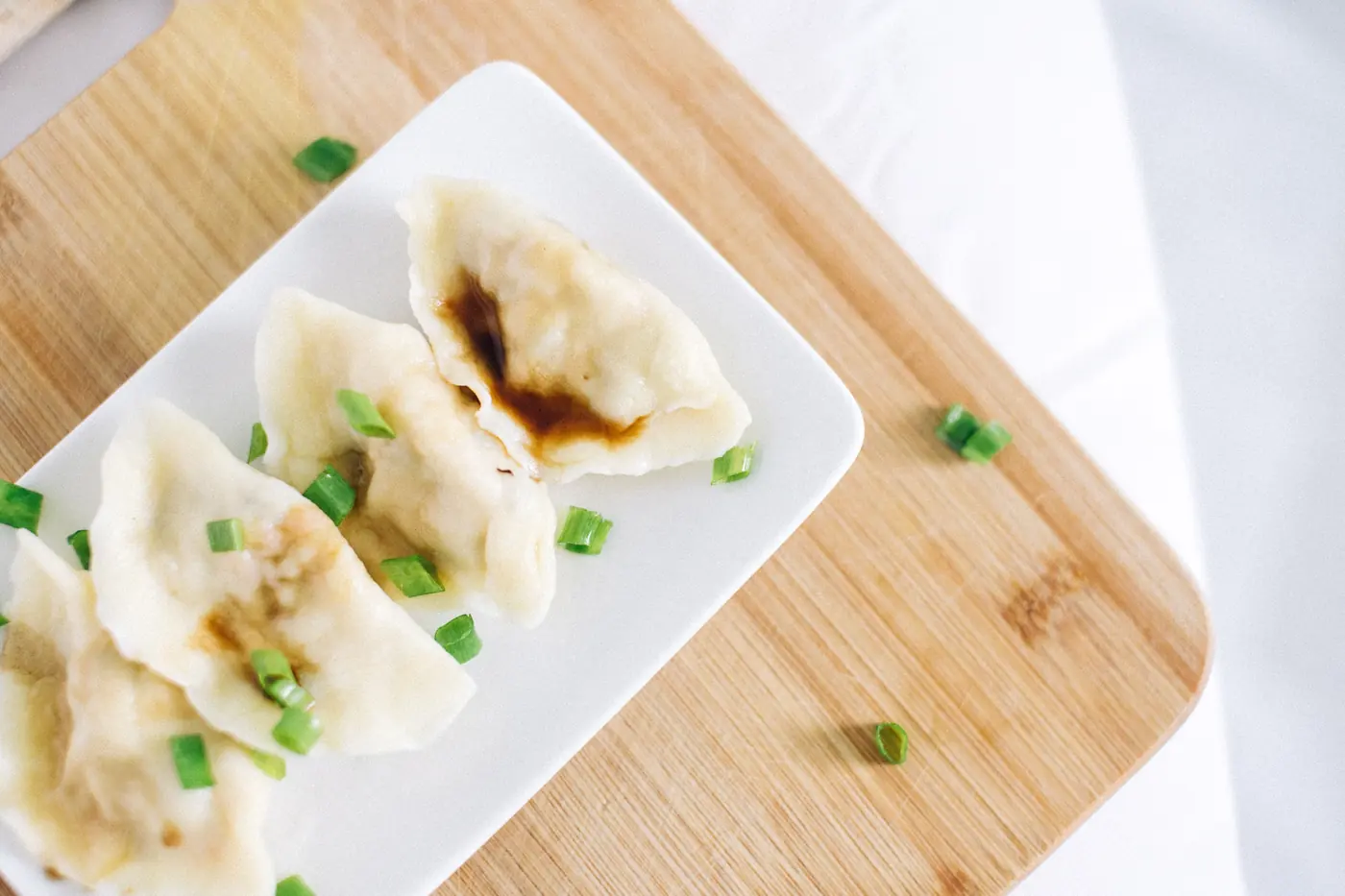
The small dish that arrives with dumplings is not soy sauce, and it is not balsamic either. Black vinegar is its own thing, and it is one of the more distinctive flavours in Chinese cooking.
What is black vinegar?
Black vinegar is a dark, aged Chinese vinegar made from glutinous rice or other grains, fermented and then matured until it darkens. It is malty, faintly sweet and much less sharp than a Western vinegar.
The best-known style comes from Zhenjiang, and bottles are frequently labelled Chinkiang. Britannica’s entry on vinegar covers the underlying process, which is the same everywhere: alcohol converted to acetic acid by bacteria, then aged.
What it tastes like
Complex in a way vinegar usually is not. There is acidity, but it arrives behind a malty, almost smoky sweetness that has more in common with a dark beer or with molasses than with anything in a salad dressing.
It is also noticeably less aggressive than white or rice vinegar. You can taste a spoonful on its own without wincing, which is not true of most vinegars, and that is why it works as a dipping sauce with nothing added.
How it is made
- Glutinous rice – sometimes wheat, sorghum or millet – is cooked and fermented into alcohol.
- The alcohol is fermented again by acetic bacteria, converting it to vinegar.
- The vinegar is aged in ceramic vessels, often for months and sometimes for years.
- During ageing it darkens, thickens slightly, and develops the malty depth that distinguishes it.
The ageing is what makes it. A young black vinegar is thinner and sharper, and the expensive bottles are expensive because of time rather than ingredients.

Why rice makes a different vinegar
Vinegar takes its character from whatever was fermented into alcohol first, and grain-based vinegars behave differently from fruit-based ones.
A grape vinegar carries fruit sugars and fruit acids, which is why balsamic tastes sweet in a recognisably fruity way. A grain vinegar starts from starch converted to sugar, and the result is maltier and rounder – closer in character to beer than to wine.
Black vinegar sits at the far end of that, because the long ageing concentrates exactly those malty notes while softening the acidity that would otherwise dominate.
The vinegars compared
| Black vinegar | Rice vinegar | Balsamic | |
|---|---|---|---|
| Colour | Very dark brown | Pale and clear | Very dark brown |
| Made from | Glutinous rice, aged | Rice, unaged | Grape must, aged |
| Sharpness | Mild | Mild but clean | Mild |
| Sweetness | Malty, savoury | Slight | Fruity, pronounced |
| Used for | Dipping, braising, noodles | Seasoning rice, pickling | Dressings, finishing |
| Substitute? | Balsamic at a push | Not for black vinegar | Not really |
Balsamic is the nearest thing most kitchens have, and it will do in an emergency, but it is markedly sweeter and fruitier. A dish made with balsamic in place of black vinegar tastes recognisably wrong to anyone who knows the original.
Where you meet it
- With dumplings – the classic use, often on its own or with a little shredded ginger through it.
- In cold dishes – dressed noodles and cold vegetable plates, where its mildness suits food that is not hot.
- In braises – added for depth in longer-cooked dishes.
- In hot and sour soup – it supplies the sour half, and the malty quality is part of why that soup tastes the way it does.
Why it suits dumplings so well
The pairing is not arbitrary. A dumpling is a parcel of fat and starch, and both coat the mouth – the wrapper is dough and the filling is usually rich.
Acidity is the standard answer to that anywhere in the world, but a sharp vinegar would fight the delicate filling. Black vinegar is acidic enough to cut through while being mild and malty enough not to overwhelm, which is a narrow target that very few vinegars hit.
It is also why the dish arrives already filled rather than as a bottle on the table. The proportion has been decided for you, and it is usually about right.
The ginger in the dish
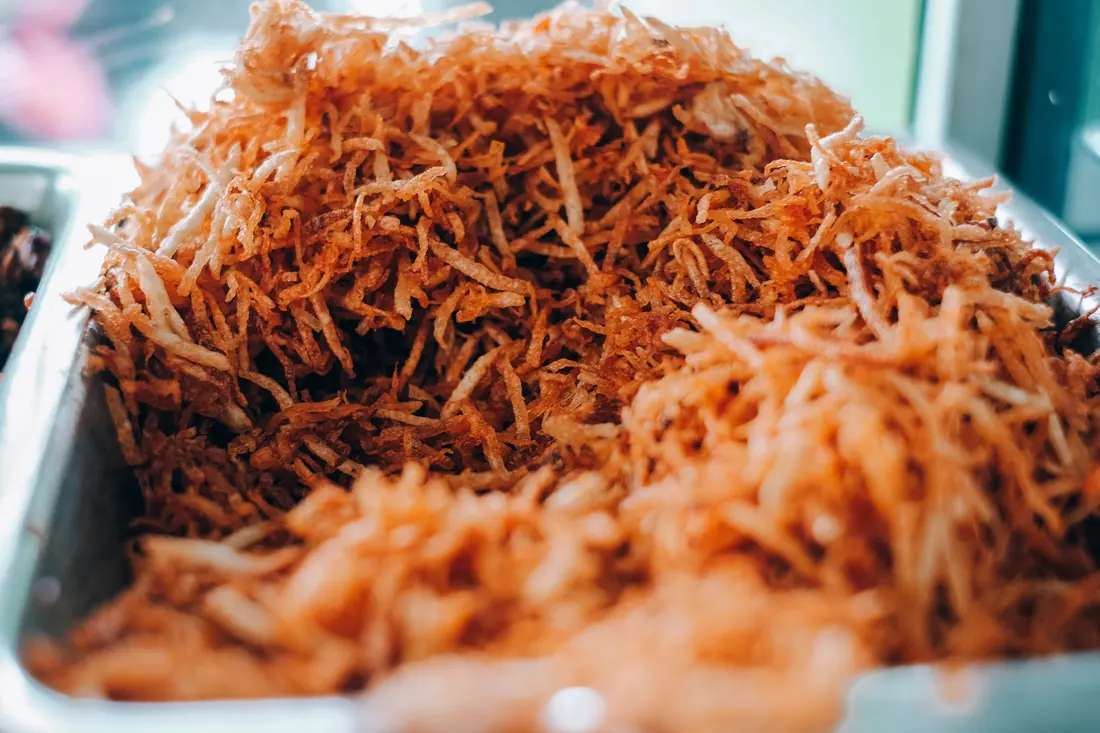
A dipping dish for dumplings frequently arrives with fine shreds of ginger sitting in the vinegar, and the pairing is deliberate rather than decorative.
The vinegar softens the ginger’s raw heat while the ginger adds a sharp aromatic note the vinegar lacks. Together they cut through the richness of a fried or fatty filling, which is exactly what a dumpling needs alongside it.
If your dish arrives with ginger in it, stirring it through rather than avoiding it is the intended use.
Cooking with it
It is not only a table condiment. Used in cooking it behaves differently from the sharper vinegars, and the difference is worth exploiting.
Added early to a braise, its acidity softens and what remains is the malty depth, which reads almost as an extra savoury element rather than as sourness. Added at the very end, the acidity survives and lifts a heavy dish.
The same bottle therefore does two quite different jobs depending on when it goes in, which is a useful thing to know and something a sharper vinegar cannot manage.
Making a dipping sauce with it
The simplest version is black vinegar alone, and it is entirely adequate. Beyond that, a few small additions are conventional.
A little soy sauce adds salt. A few drops of sesame oil add aroma. A spoonful of chilli oil adds heat and richness. Shredded ginger adds sharpness. The proportions are a matter of taste and most people settle on roughly three parts vinegar to one part everything else.
What it does not want is sugar. The malty sweetness is already there, and adding more flattens the acidity that makes it useful.
Where the style comes from
Zhenjiang, on the Yangtze in eastern China, is the city most associated with it, and bottles labelled Chinkiang are using the older romanisation of that name. The style has been made there for centuries and carries a protected designation recognising the region.
Other regions make their own versions. Shanxi produces an aged vinegar that is sharper and smokier, and there are lighter styles elsewhere that are closer to a plain rice vinegar in character.
If a recipe simply says black vinegar, the Zhenjiang style is what it means. It is the most widely exported and the one most kitchens outside China have.
Buying a bottle
Look for a short ingredient list – grain, water, salt – and an indication of ageing. Bottles listing caramel colour high up are usually young vinegar darkened to look older.
It keeps effectively forever in a cupboard. Vinegar is self-preserving, and an open bottle will still be good long after most other condiments in the same cupboard have gone.
For the dishes it accompanies, our guide to fried wontons covers the parcels it turns up beside, the roll comparison covers the other fried appetisers, and the condiments guide covers the equivalent dishes on the Japanese side. The current selection is on the ordering page.
Frequently Asked Questions
What is black vinegar?
A dark aged Chinese vinegar made from glutinous rice or other grains. It is malty and faintly sweet, and much milder than Western vinegars.
What does black vinegar taste like?
Malty and almost smoky, with the acidity arriving behind the sweetness. Closer to dark beer or molasses than to a salad vinegar.
Is black vinegar the same as balsamic?
No. Balsamic is made from grapes and is much sweeter and fruitier. It is the nearest common substitute but the difference is noticeable.
What is the ginger in the dumpling dipping dish for?
The vinegar softens the ginger’s raw heat and the ginger adds a sharp aromatic note. Together they cut the richness of the filling. Stir it through.
Does black vinegar go off?
Effectively no. Vinegar is self-preserving and an opened bottle keeps in a cupboard for years.