
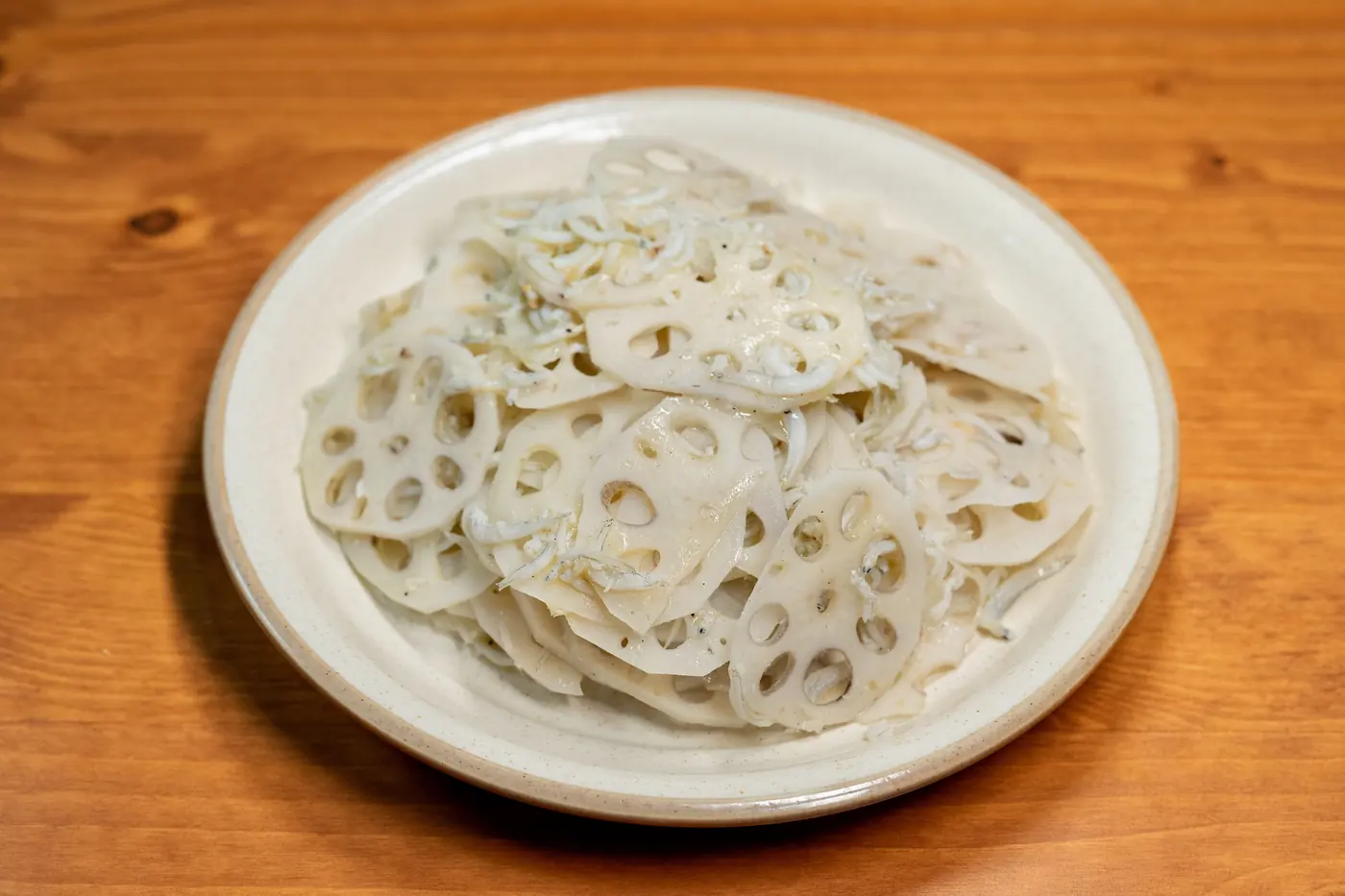
Pale discs with a ring of holes through them, arranged so neatly that people regularly assume they were cut that way. They were not – the holes are the plant, and the reason for them is the most interesting thing about the ingredient.
What it is
Lotus root is the rhizome of the sacred lotus – the underwater stem, not a root in the botanical sense, though nobody calls it anything else. It grows in the mud at the bottom of ponds and paddies, in linked segments like a string of pale sausages.
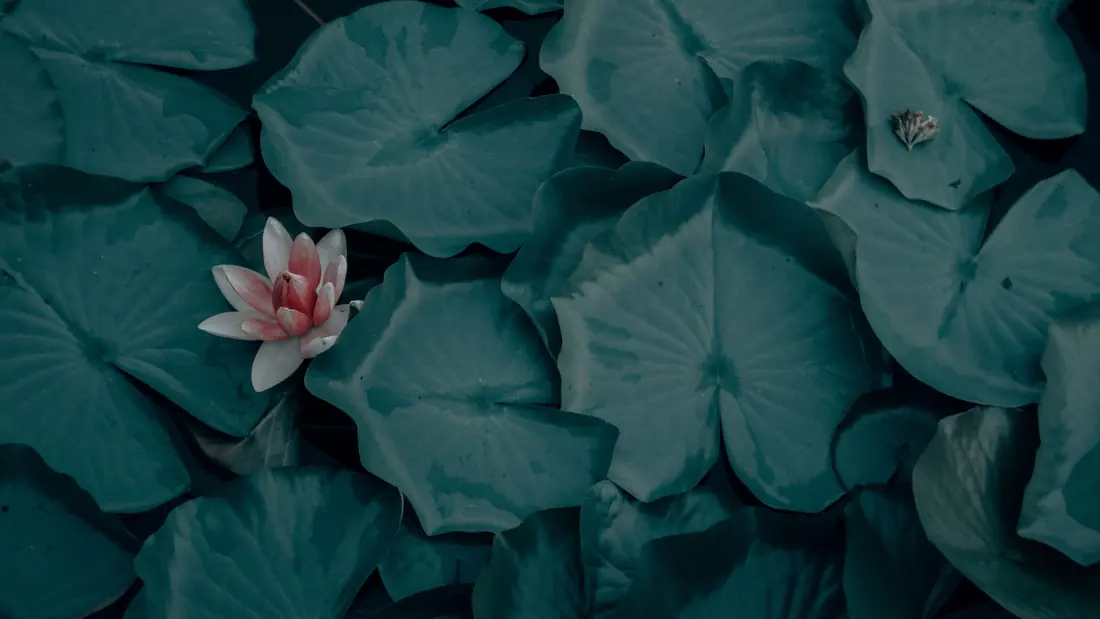
Britannica’s entry on the sacred lotus covers the plant above the water, which is the part most people have seen – the broad floating leaves and the large pink flower that sits above them.
Why it has holes
The holes are air channels, and they exist because of where the plant lives. The rhizome is buried in mud at the bottom of still water, where there is effectively no oxygen, while the leaves are up in the air.
The channels run the length of the rhizome and connect it to those leaves, carrying air down to the buried parts of the plant. It is a snorkel, in other words, and the pattern you see on a slice is a cross-section of the pipework.
The arrangement is remarkably consistent – a ring of larger channels around a smaller central one – which is why slices from the same root all look like variations on one design. That regularity is also why the vegetable is used decoratively so often.
What it tastes like
Mild, slightly sweet and faintly starchy – closer to a water chestnut or a raw potato than to anything strongly flavoured. It is not there for its taste.
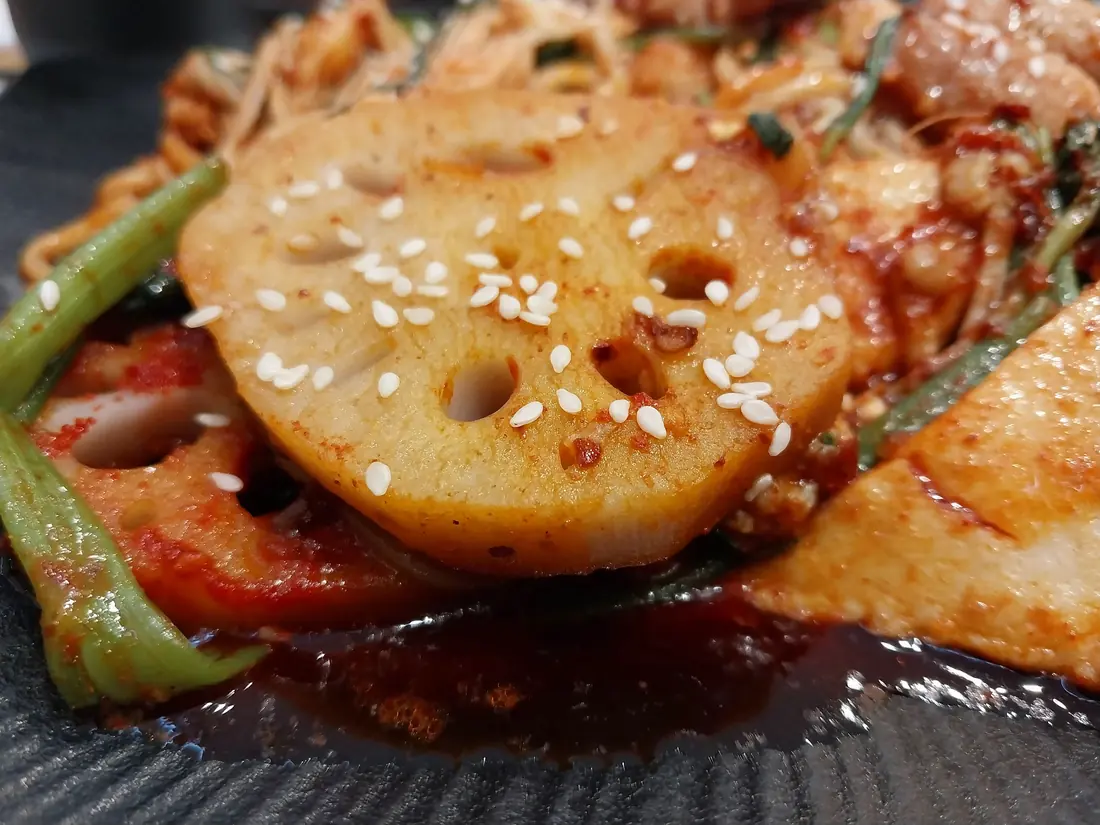
What it is there for is texture. Lotus root is crisp in a way that survives cooking, with a clean snap when raw and a firm bite when simmered. It is one of the small group of vegetables that can go into a long-cooked dish and still be recognisable when it comes out – our piece on bamboo shoots covers the other one you meet most often.
The threads
Snap a fresh piece in half slowly and fine sticky threads stretch between the two halves, like a much finer version of melted cheese.
They are entirely harmless, and they are a sign of freshness rather than a problem – the threads come from the same tissue that makes the rhizome flexible under water. In several East Asian traditions they carry a symbolic reading too, standing for connections that hold, which is part of why the vegetable turns up at new year and at weddings.
How it is served
| Preparation | What it does to the texture | Where you meet it |
|---|---|---|
| Thin and deep fried | Crisp all the way through, like a crisp | Snacks and garnishes |
| Simmered in a seasoned broth | Softens slightly, stays firm | Braised and simmered dishes |
| Stir fried in slices | Keeps its snap entirely | Mixed vegetable dishes |
| Pickled | Sharp and very crisp | Side dishes and salads |
| Stuffed and steamed | Soft, with the filling in the holes | Banquet cooking |
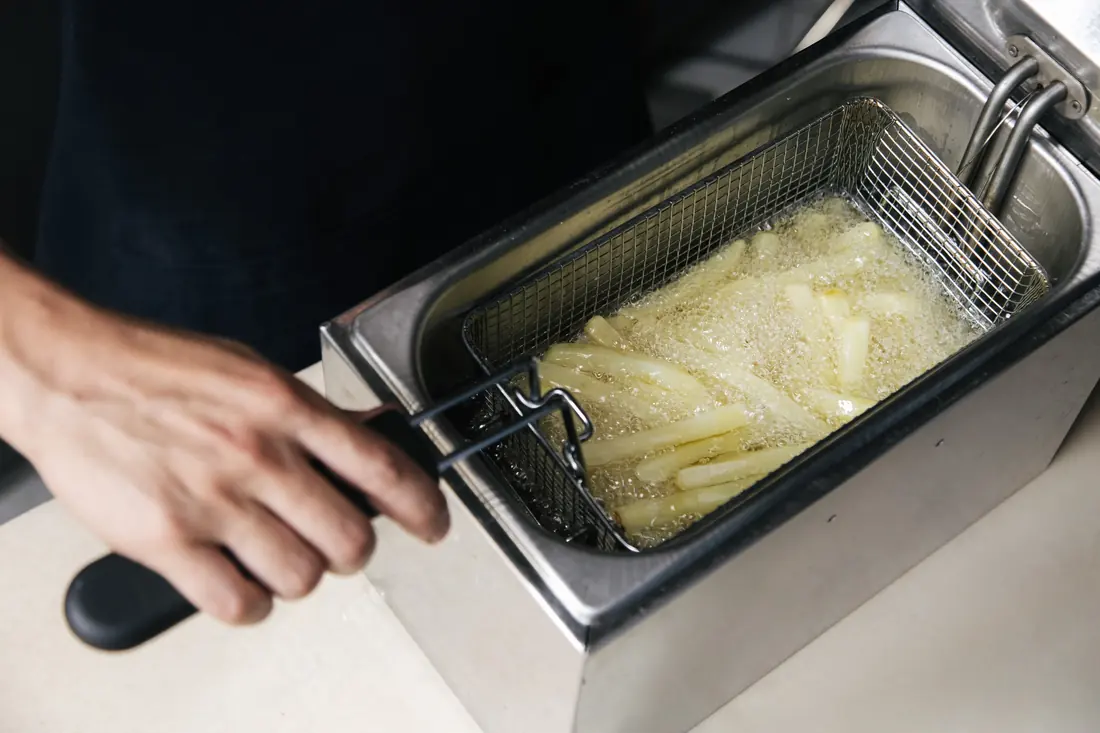
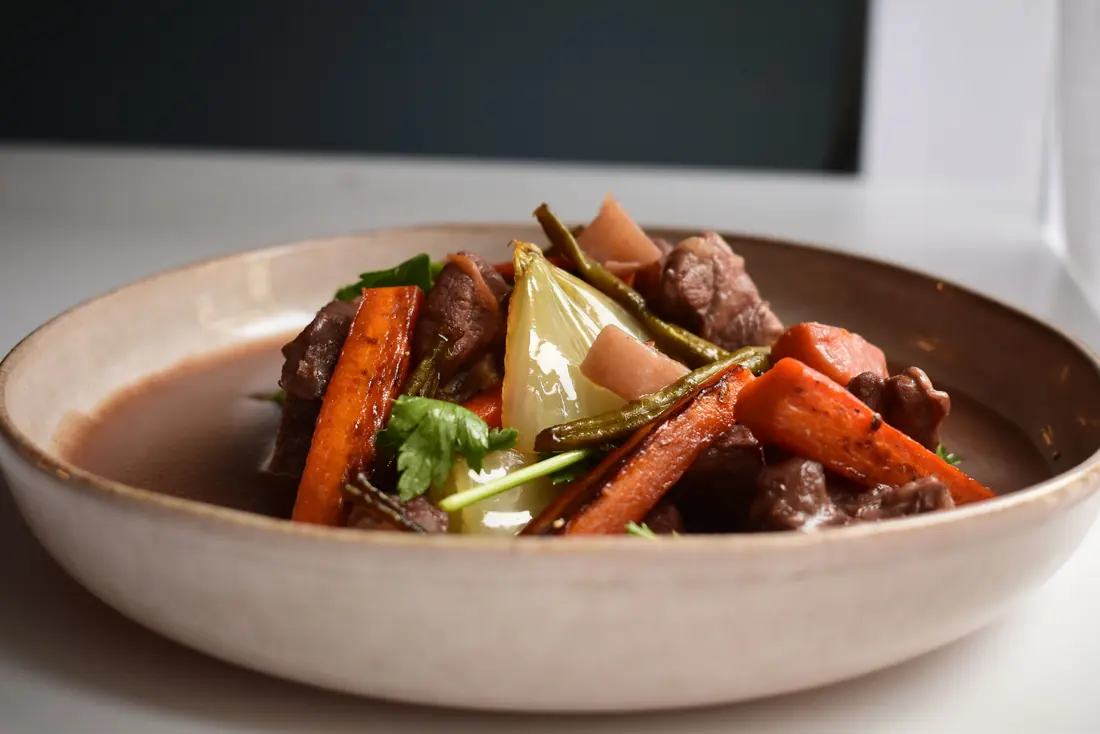
The fried version is the one most people meet first, usually as a garnish sitting on top of something else. Sliced thin enough, it behaves exactly like a vegetable crisp and the holes make it look considerably more impressive than the effort involved.
Where it grows, and why it is muddy
Lotus is cultivated in shallow standing water – ponds, flooded fields, the margins of slow rivers – across China, Japan, Korea, India and Southeast Asia. The rhizome grows horizontally through the mud rather than downward, which is why the segments come out in a chain.
Harvesting is genuinely hard work. There is no machine that does it well, so it is largely dug by hand from waist-deep mud, feeling for the chain and lifting it out without snapping the segments. A broken segment fills with water and mud and does not keep, which is most of why the intact ones cost what they do.
The rest of the plant is food too
Very little of a lotus goes unused, which is unusual even among plants grown for food.
- The seeds – eaten fresh like a nut, dried and simmered in sweet soups, or ground into a sweet paste used as a filling.
- The leaves – large, waxy and waterproof, used to wrap rice and other fillings before steaming, which perfumes what is inside.
- The stems – sliced into salads in Southeast Asian cooking.
- The flower – the part everyone recognises, and the reason the plant carries the symbolic weight it does across several religions.
The seed pod is worth seeing once. It looks like a shower head, holds the seeds in individual sockets, and dries into a shape used in flower arranging long after the plant has finished.
Buying it
It is sold fresh as linked segments, vacuum-packed in sections, frozen in slices, and dried. Fresh is best and the least convenient; frozen slices are the most practical for home cooking and lose surprisingly little.
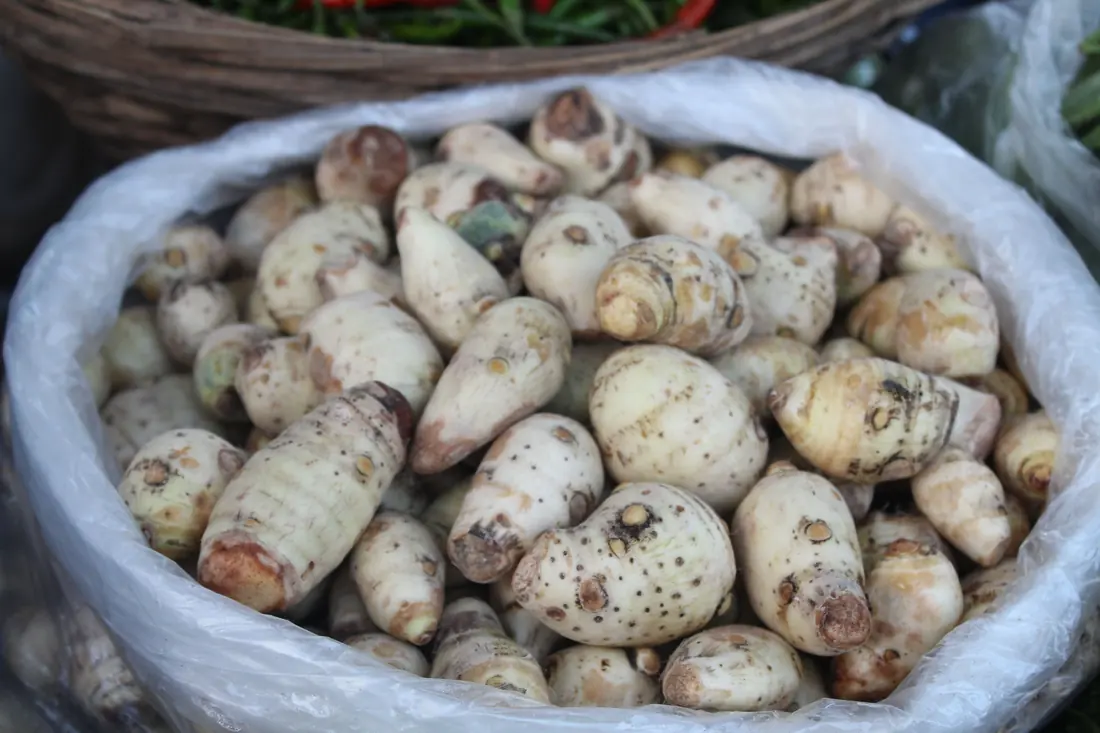
- Look for unbroken skin. A cut or snapped end lets mud and water in, and the inside discolours from there.
- Heavier is better. A light segment has dried out and will be woody.
- Avoid soft patches. It should be firm along its whole length.
- Expect mud. A clean-looking root has been washed, which shortens how long it keeps.
Fresh, frozen, canned and dried
The form changes the ingredient more than it does with most vegetables, so it is worth knowing what you are buying.
Fresh is crisp and clean-tasting and needs peeling, trimming and acidulated water. Frozen slices are already peeled and cut and lose very little of the snap, which makes them the sensible default for home cooking. Canned is softer and carries a faint tinned note that needs rinsing out, and is best used where the texture is not the point. Dried slices are used in soups and teas and rehydrate to something chewier than any of the others.
There is also lotus root starch, sold as a powder and used as a thickener and in drinks, which is a different product entirely and not a substitute for the vegetable.
Preparing it
- Cut the segments apart at the narrow joints and peel each one.
- Slice across the rhizome so the holes show as a ring – this is the point of the vegetable.
- Drop the slices straight into water with a splash of vinegar; cut surfaces brown quickly.
- Rinse before cooking, and check the holes for grit.
- Cook briefly if you want the snap, longer if you want it tender – it will not turn to mush either way.
The acidulated water step matters more than it sounds. Lotus root oxidises fast, and a slice left on the board turns a grey-brown that no amount of cooking will brighten.
For the other vegetables that behave this way, the bamboo shoots piece covers the other one that refuses to soften, the daikon explainer covers the white radish that does the opposite, and the mushroom guide covers the other texture ingredient on the same plate. The current selection is on the ordering page.
Frequently Asked Questions
What is lotus root?
The rhizome – the underwater stem – of the sacred lotus plant. It grows in mud at the bottom of ponds in linked pale segments.
Why does lotus root have holes?
They are air channels running the length of the rhizome, carrying oxygen from the leaves above the water down to the buried stem.
What does lotus root taste like?
Mild and slightly sweet, a little starchy – not unlike a water chestnut. It is used for its crisp texture rather than its flavour.
What are the sticky threads in lotus root?
Fine strands from the tissue that keeps the rhizome flexible. They are harmless and are generally taken as a sign of freshness.
Why does lotus root turn brown?
It oxidises quickly once cut. Dropping the slices into water with a splash of vinegar prevents it.