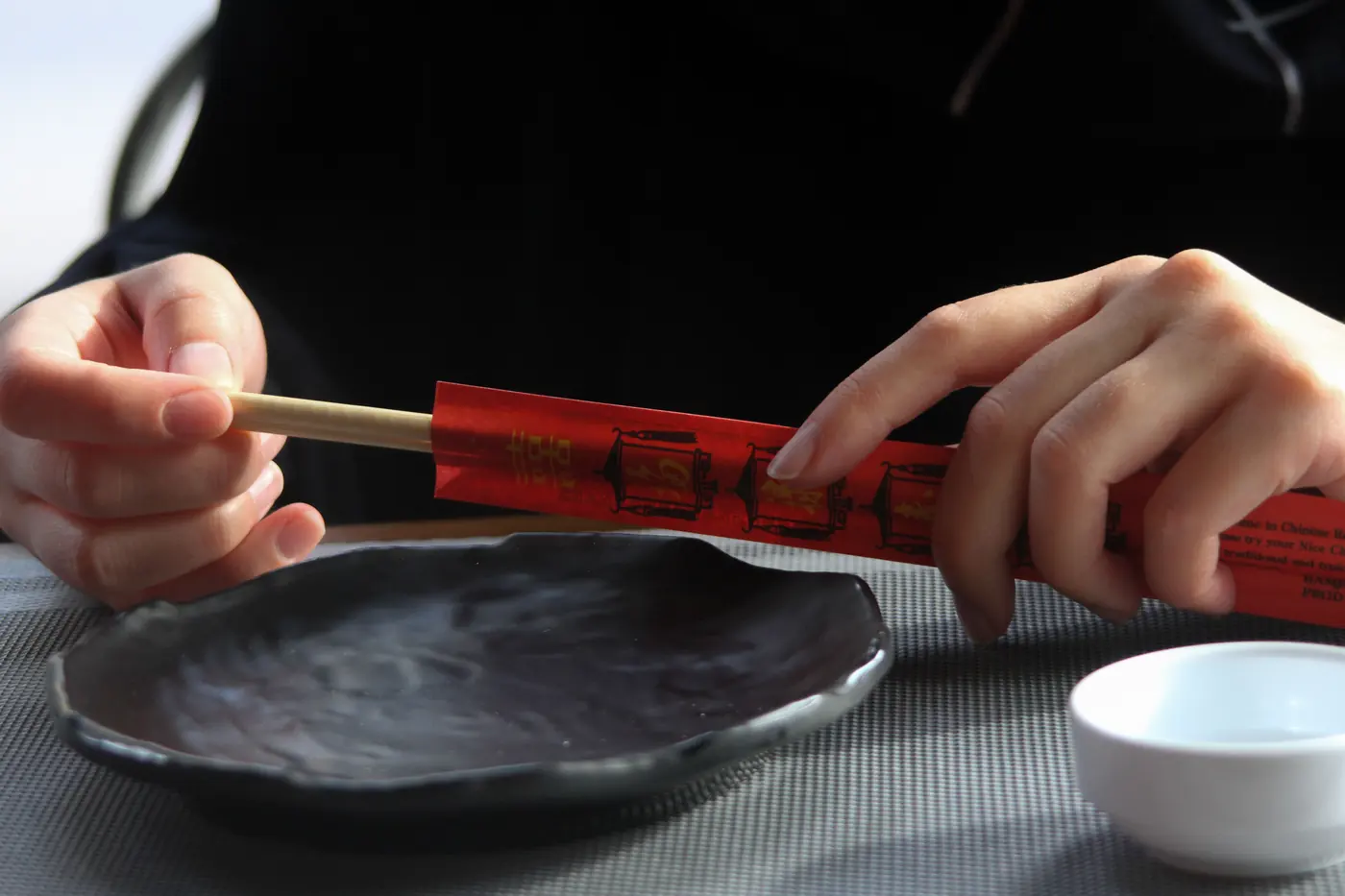
The grip takes about ten minutes to learn and most guides stop there. The part that actually matters at a table is the handful of things you should not do with them, and why – some of it is etiquette, and some of it is genuinely serious.
The grip
One stick is fixed and one moves. That is the whole principle, and almost every difficulty comes from trying to move both.
- Rest the lower stick in the hollow between thumb and index finger, with its far end supported on the tip of your ring finger. This one never moves.
- Hold the upper stick like a pencil, between the tips of your thumb, index and middle fingers.
- Move only the upper stick, pivoting it against the lower one to open and close.
- Keep the tips level – if they cross, your hand is too far down the sticks.
- Hold them about two thirds of the way up, not near the tips.
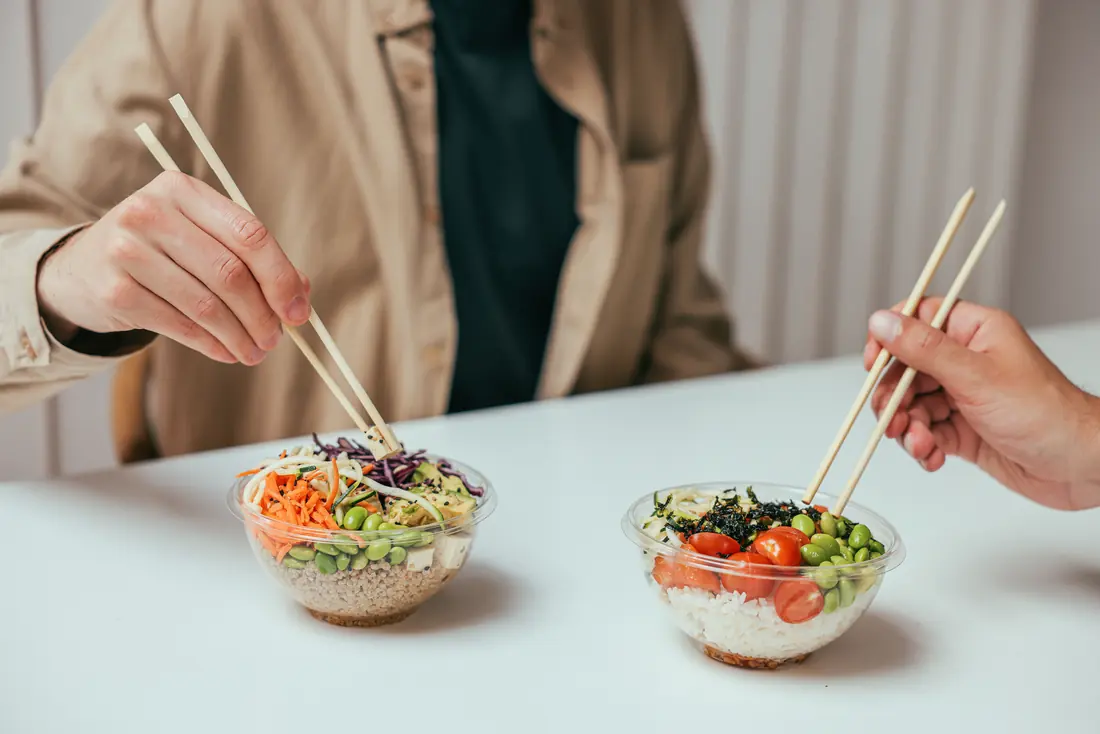
If the tips scissor past each other, the fault is almost always the lower stick having drifted out of the thumb hollow. Reset it and the rest usually corrects itself.
Where they came from
Britannica’s entry on chopsticks traces them to China well over three thousand years ago, spreading with Chinese cultural influence to Japan, Korea and Vietnam.
The design differs by country, which is why a set from one place feels wrong if you learned on another.
| Chinese | Japanese | Korean | |
|---|---|---|---|
| Length | Longest | Shorter | Medium |
| Tip | Blunt, squared | Pointed | Flat, often blunt |
| Material | Usually wood or melamine | Usually wood, lacquered | Usually metal |
| Suits | Reaching across shared dishes | Picking apart fish | Firm grip, heavier |
The Japanese point is the relevant one at a sushi counter – it is designed for lifting something delicate without tearing it, which a blunt Chinese tip does less well.
The things not to do
Two of these are serious and the rest are ordinary manners.
- Do not stand them upright in rice. This is the important one. Vertical chopsticks in a bowl of rice resemble incense at a funeral offering, and it reads as a bad omen rather than as clumsiness.
- Do not pass food chopstick-to-chopstick. Also funerary – bones are passed this way after a cremation. Put the food on a plate instead.
- Do not spear food. Using them as a fork is read as giving up.
- Do not wave them or point. Same as pointing with cutlery anywhere.
- Do not rub disposable ones together. A common habit, and it implies you think the restaurant gave you cheap splintery ones.
The first two are worth taking seriously in a way the others are not. Nobody minds an awkward grip; the funeral associations are a different category of mistake and are easy to avoid once you know.
Practising without a meal in front of you
The fastest way to learn is not at a restaurant with food going cold. Twenty minutes with a bowl of dried beans, moving them one at a time between two bowls, builds the movement faster than a month of meals.
Beans are ideal because they are smooth, small and unforgiving – anything you can pick up reliably from a flat surface will be easy in a bowl. Cubes of something soft are the next step, since they teach pressure control rather than grip.
Where to put them down
Across the rest if there is one – the small ceramic or wooden object beside your plate is for exactly this. If there is not, lay them across the edge of a small dish, or on the paper sleeve they came in, folded into a rest.
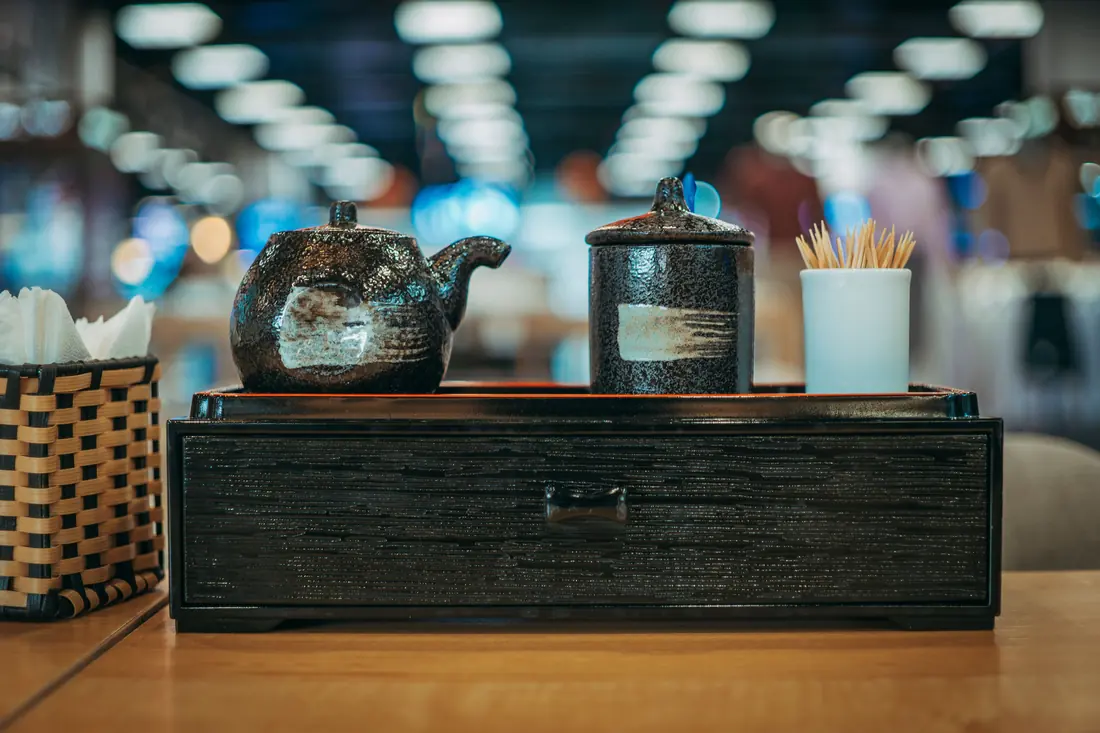
What to avoid is laying them directly on the table with the tips touching it, or leaving them across the top of a bowl, which in some settings signals you have finished.
The disposable ones
Waribashi – the split-apart wooden pair – are their own small subject. They come joined at one end and are pulled apart at the table, which is a freshness guarantee as much as a manufacturing convenience: a pair that has already been separated has already been used.
Pull them apart vertically rather than levering them sideways, and do it low, near the table, rather than up at chest height. Both are minor points of manners, and both reduce the chance of the split going crooked and leaving a splinter.
The paper sleeve they arrive in is genuinely useful. Folded a few times it makes a perfectly good chopstick rest, which is what a lot of people do with it automatically without knowing that is the convention.
Sushi is a special case
Sushi is the one thing on the table you are explicitly permitted to eat with your hands, and doing so is traditional rather than lazy. Our beginners guide covers the reasoning: a piece held by the fingers keeps its shape, where chopsticks squeeze it.
Sashimi is the exception to the exception – that is chopsticks, because there is no rice to hold it together.
Metal ones are harder, and that is not your fault
Korean chopsticks are traditionally metal, often flat rather than round, and they are noticeably more difficult for a beginner. They are heavier, slipperier and give less grip on anything smooth.
If you learned on wood and find a metal pair unmanageable, the tool changed rather than your competence. The usual advice is to hold them slightly further down and accept smaller mouthfuls, and to use the accompanying spoon for rice rather than fighting it – which is what the spoon is there for.
Noodles are their own skill
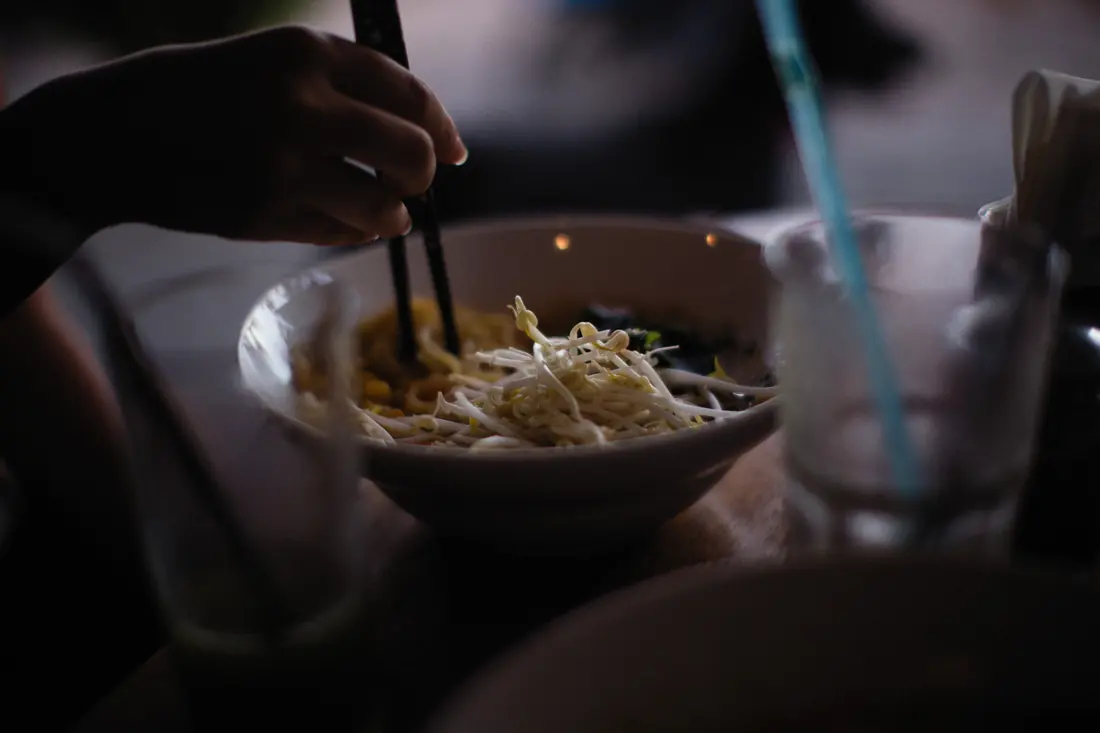
A bowl of noodles in broth is where chopsticks feel hardest and where the technique is actually simplest: lift a small amount clear of the broth, let it drain for a second, and bring the bowl up to meet you.
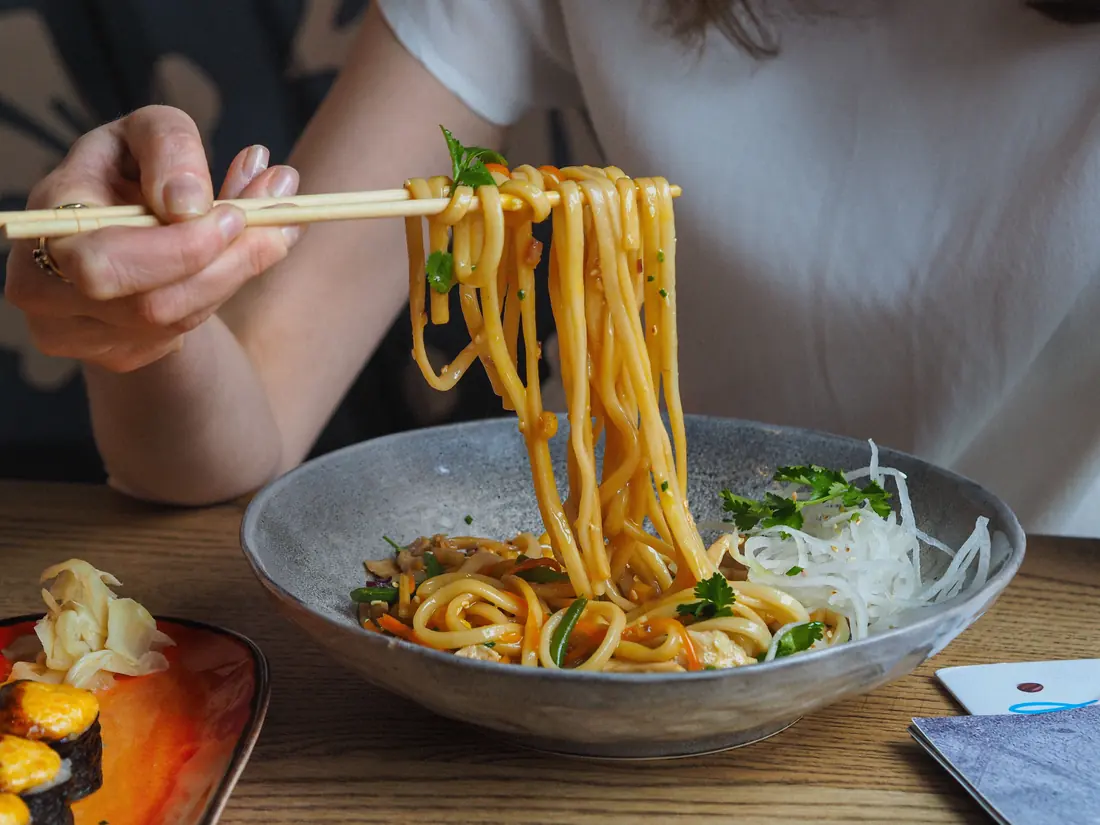
Lifting the bowl is not rude. In Japanese practice a rice or soup bowl is meant to be picked up, and trying to eat noodles from a bowl left flat on the table is the actual mistake. Our guide to eating pho covers a bowl where the spoon and chopsticks work together.
If you are struggling
Ask for a fork. Nobody minds, and every restaurant serving a general public has them. The idea that requesting cutlery is an insult is largely imagined by the person doing the requesting.
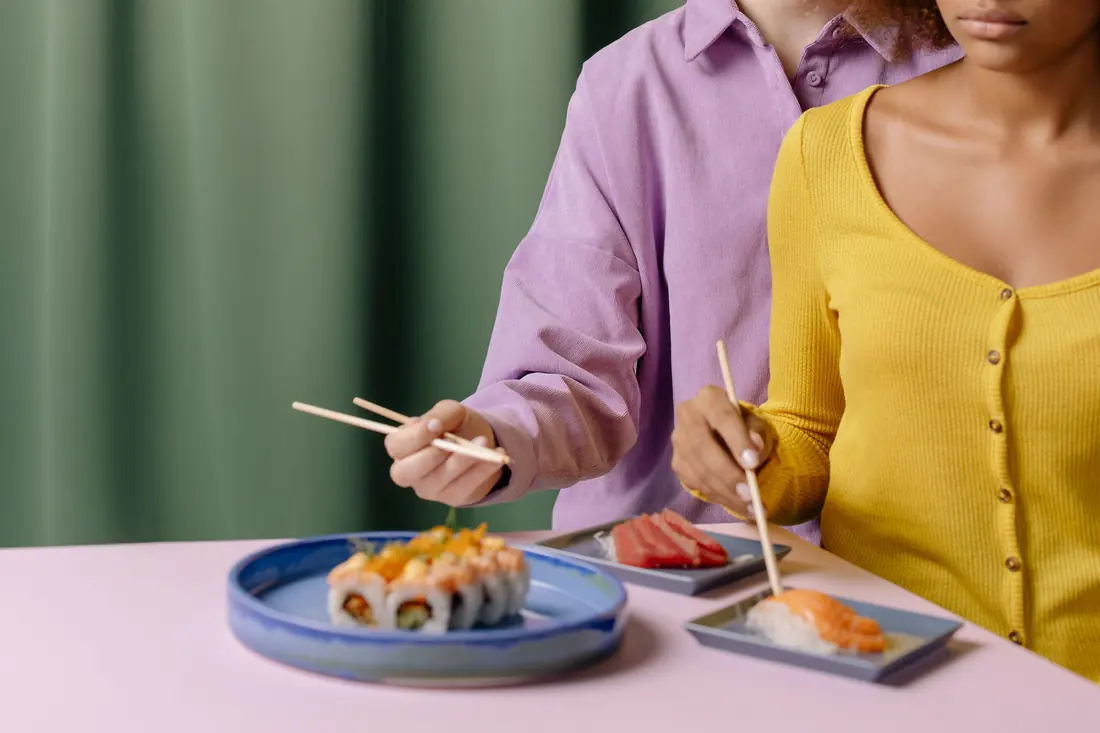
The middle path is to use chopsticks for the easy things and a fork for the difficult ones, which is what a great many people who grew up with both do anyway.
For the food itself, the beginners guide covers what to order and how to eat it, the hand roll piece covers the one you should definitely use your hands for, and the pho guide covers the bowl that needs both hands. The current selection is on the ordering page.
Frequently Asked Questions
How do you hold chopsticks?
The lower stick rests in the thumb hollow and on the ring finger and never moves. The upper stick is held like a pencil and pivots against it.
Why should you not stand chopsticks upright in rice?
It resembles incense sticks in a funeral offering, so it reads as a bad omen. Passing food chopstick-to-chopstick is avoided for the same reason.
Is it rude to eat sushi with your hands?
No – it is traditional. Holding a piece by the fingers keeps its shape where chopsticks squeeze it. Sashimi is eaten with chopsticks.
Where do you put chopsticks down?
Across the rest if there is one, or across the edge of a small dish. Avoid laying the tips directly on the table.
Is it acceptable to ask for a fork?
Yes, and it is not treated as an insult. Plenty of people use chopsticks for some things and a fork for others.